 Photo art by Cynthia Burgess
Tuesday, April 10, 2007


Learn to be responsive to change
Well, I didn't know he said this:
It will do us all good to ponder this.It is not the strongest of the species that survives, nor the most intelligent, but the one most responsive to change.
Monday, April 09, 2007
Now
Now is the only time. How we relate to it creates the future. In other words, if we're going to be more cheerful in the future, it's because of our aspiration and exertion to be cheerful in the present. What we do accumulates; the future is the result of what we do right now.
-- Pema Chödrön
Sunday, April 08, 2007

Saturday, April 07, 2007
The value of silence
This morning I came across a little article called "Transforming the world through silence". Here's an excerpt:
We live in an unhealthy society of noise. No matter where we turn in our daily lives, noise can be found in abundance. As a health-care worker, I fear that we often become immune to the noise around us, but it is taking its toll on our lives.Do what you can to give yourself the marvelous gift of silence. It will, indeed, transform you.
We now know from experts that the noise of our daily lives is harmful to our health and it is recognized as an environmental pollutant.
Silence, on the other hand, has many benefits, yet it seems rare and infrequent in our busy lives. Silence takes time, discipline and commitment.
We generally need to physically move to another place or space to be quiet and still for even a brief period of time.
Thomas Merton, the late Trappist monk and author, once said, "Silence is not a luxury, it is a necessity." It is unfortunate that we don't take daily advantage of solitude and silence.
Silence is much more than a noise-free environment. Silence is the foundation of balance and tranquility. It heals the heart, builds and sustains relationships and has the possibility of healing our broken and turbulent world.
Friday, April 06, 2007

Sacred Activism Conference
Hello, folks. I want to remind you of the Sacred Activism Conference held in Tulsa next month. It's really a wonderful opportunity for us all. Lauren Artress, Robert Kennedy Jr., Carolyn Myss, Andrew Harvey and Michael Lerner among others will be speaking. I will be giving a meditation workshop, too! Please check out the following website and plan on attending!
A blessing for today
May you be at peace.
May your heart remain open.
May you awaken to the light of your own true nature.
May you be healed.
May you be a source of healing for all beings.
Thursday, April 05, 2007

Meditation and the homeless
Do you think meditation is only for the affluent? Not so according to Rev. Rev. Jana Drakka. Take a look at part of an article called "Woman Offers Meditation To The Homeless":
San Francisco, USA -- If you are homeless in the Bay Area, there are a number of places you can turn to for shelter, clothing and food. But none is as unusual as a one-woman effort now underway in San Francisco. She's offering peace of mind.Meditation is truly for everyone in every life circumstance.
The practice of meditation has been around for thousands of years. But what's happening in this room is unique. This is believed to be the first meditation project in the nation designed for those who are homeless or living on the edge.
Rev. Jana Drakka, Buddhist monk: "Our aim is to be at peace with whatever comes up."
You might think meditation is something only yuppies do, but one purpose of meditation is to reduce stress, and as anyone living on the streets will tell you, it's certainly stressful being homeless.
...
Steve Eastman believes meditation is helping him move forward despite being surrounded by poverty, violence, alcohol and drugs.
Steve Eastman, meditation client: "The more calm, the more centered, the more rational you are, the more likely it is that you can get some services or find some help."
Tuesday, April 03, 2007
Genuine love for another
Do you love someone only to find yourself trying to change that person? Take a look at this observation:
It is very hard to be the one who is twisted to conform to another's image. And there is nothing more wonderful than to be loved for oneself.The beginning of love is to let those we love be perfectly themselves, and not to twist them to fit our own image. Otherwise we love only the reflection of ourselves we find in them.
Monday, April 02, 2007

About affirmation
It's really important to affirm others:
What would happen if we decided to fill people's lives with sweetness? There would be so much more happiness in the world, wouldn't there?Do not keep the alabaster box of your friendship sealed up until your friends are dead. Fill their lives with sweetness. Speak approving, cheering words while their ears can hear them, and while their hearts can be thrilled and made happier. The kind of things you mean to say when they are gone, say before they go.
Sunday, April 01, 2007
Come to the end of words
Here's a passage from Staying Put by Scott Russell Sanders that I found very moving:
Nothing less than the undivided universe can be our true home. Yet how can one speak or even think about the whole of things? Language is of only modest help. Every sentence is a wispy net, capturing a few flecks of meaning. The sun shines without vocabulary. The salmon has no name for the urge that drives it upstream. The newborn groping for the nipple knows hunger long before it knows a single word. Even with an entire dictionary in one's head, one eventually comes to the end of words. Then what? Then drink deep like the baby, swim like the salmon, burn like any brief star.Here we see an exaltation of silence. And that is a good thing.
Saturday, March 31, 2007
Tame that restless mind!
I have a wonderful story to share with you today. It's the "Thought for the Day" from the Blue Mountain Center of Meditation and Nilgiri Press. Take a look:
There is a Hindu story comparing the mind to the trunk of an elephant – restless, inquisitive, always straying. In our villages in India, elephants are sometimes taken in religious processions through the streets to the temple. The streets are crooked and narrow, lined on either side with fruit and vegetable stalls. Along comes the elephant with his restless trunk, and in one sinuous motion, he grabs a whole bunch of bananas. He opens his cavernous mouth, and tosses the bananas in – stalk and all. From the next stall he picks up a coconut and tosses it in after the bananas. No threats or promises can make this restless trunk settle down. But the wise elephant trainer will give that trunk a short bamboo stick to hold. Then the elephant will walk along proudly, holding the bamboo stick in front like a drum major with a baton. He doesn’t steal bananas and coconuts now, because his trunk has something to hold onto.You know, any meditation support will work to tame the elephant's trunk - not just a mantra. Simply bringing the mind back over and over to the present moment is a powerful way of taming the restless mind. It is also the most reliable way to happiness I know. Add to that both compassion and lovingkindness and you have a prescription for bliss!
The mind works in the same way. We can keep it from straying into all kinds of situations if we just give it the mantram.
Friday, March 30, 2007

Silence
I want to bring you another excerpt from Choosing Civility that I mentioned on Wednesday. The "rule" discussed is "Keep It Down (and Rediscover Silence)". Here's the passage:
In an age when background noise are virtually constant, we are slowly becoming inured to noise. At the same time, many of us are ready to reacquaint ourselves with silence. We are beginning to realize that silence is not a void waiting to be filled, just as an immaculate church wall is not there to be defaced with spray paint. Silence is not necessarily the sign of a failure to communicate. Instead, it can be the refreshing result of a choice. We often surround ourselves with chatter and sundry sounds because we don't want to be alone with our thoughts. While noise takes us away from ourselves, through silence we build bridges to our own souls. Ultimately, the challenge to all of us on the threshold of the new century (which threatens to be a noisy one) is to treat silence as an endangered precious resource. There is an urgent need for advocates of silence. There is an urgent need for gatherers of tranquility.Learning to meditate is one way to reacquaint oneself with silence. Many people are uncomfortable with silence because they don't know what to "do" with it; they don't know how to manage their thoughts. A commitment to meditation makes silence very welcome indeed.
Thursday, March 29, 2007
Stress reduction
Here's an excerpt from an article entitled "How 5 Minutes of Meditation a Day Can Save Your Life":
How to meditate to reduce stressA very important point made here is not to judge thoughts as either "good" or "bad". Just let them go and return to the meditation support which might be breath or sound or a mantra. Or it could be simply watching your thoughts.
This is so easy you will wonder why you haven’t been doing it all your life.
First start by slowly turning your mind inwards so that instead of focussing on the external appearances of sight, smell, etc. you are looking at your thoughts. Become aware of them. How do they move? Where do they come from? Where do they go?
Do not try to change the thought. Do not judge “bad” thoughts and do not reward “good” thoughts. Just be aware of them. After some time you will be able to watch your thoughts quite easily without becoming distracted or frustrated.
Meditating in this way will allow you to be able to recognize thoughts when they first arise. This is a powerful tool in reducing stress as you realize that it is just a thought, not solid. By simply recognizing our thoughts we reduce their power and thus can reduce the effects they have on our life.
Wednesday, March 28, 2007

"I could be wrong!"
Today in ongoing class we talked about the book Choosing Civility by P.M. Forni. The book's subtitle is, "The twenty-five rules of considerate conduct." Many people, sadly, have not been taught such rules during their upbringing and so would definitely benefit from a book like this. All of us would do well to review the basic pinciples of considerate behavior. The "rule" that we looked at in class today was this one: "Be Agreeable."
Here's an excerpt from that chapter:
Here's an excerpt from that chapter:
At any given moment, on any issue, there is the possibility that YOU might be wrong and someone else might be right. Keep that possibility in mind. Then, if you realize that you are wrong, find the strength to acknowledge it openly. Do so graciously, without harboring resentment toward the person who happens to be right. The same awareness and openness apply to not knowing. We are not omniscient and nobody expects us to be. So, reconcile yourself with not knowing and admit that fact to your interlocutors. Training yourself to consider that you might be wrong and to admit that you don't know will mark a crucial point in your relationships. Accepting those limitations about yourself will make you much more accepting of others. You will listen to learn rather than to react and you will be less likely to attack, to be dismissive, to doubt good intentions, and to be dogmatic.I'm impressed with the list of benefits in that last sentence. That's quite a payoff from the willingness to acknowledge that we can be wrong or that we simply might not know something.
Tuesday, March 27, 2007
Full attention
Here's a reflection on complete attention from the Blue Mountain Center:
By giving full attention to one thing at a time, we can learn to direct attention where we choose. Simple, yet essential to the practice of love! Being one-pointed means we can give the person we are with our complete attention, even if she is contradicting our opinion on tax reform or explaining the peculiarities of French grammar. Once we can do this, boredom disappears from our relationships. People are not boring; we get bored because our attention wanders. When we can give someone our full attention, our attitude says clearly, “You matter to me. You have my respect.”I like the point that people are not boring. It's true that if we make a commitment not to be bored, we will discover what is interesting about everybody!
Monday, March 26, 2007

Attachment to results
Here's a passage from the Bhagavad Gita called to my attention by Misty Diaz:
Those whose consciousness is unified abandon all attachment to the results of action and attain supreme peace. But those whose desires are fragmented, who are selfishly attached to the results of their work, are bound in everything they do.This is a very important principle for those who work in the helping professions. Discouragement can easily set in when a social worker tries to help people change and they don't change or a teacher tries to help students learn and they don't learn. That doesn't mean the work isn't valuable. It means the work must be done for its own sake and not for the outcome. Working for a specific outcome all the time is definitely a prescription for burn-out.
Sunday, March 25, 2007
A meditation on love
This is from a book by Miguel Ruiz entitled Prayers: A Communion with our Creator:
Today, imagine all the love flowing from your heart to all the people who need your love. Join your heart with my heart, and together let’s offer our love to the world. By putting our hearts together and sending our love to all of humanity, the moment will come when their hearts will react to that love. They will express their love also, the same way that we are expressing our love.I'm struck with the emphasis on sending love to those who need our love. They may not want it, they may not know they need it. Doesn't matter. We need to cultivate the willingness to give love to those who need it whether we particularly like the idea or not.
Saturday, March 24, 2007
Meaning
Don't try to become happy by avoiding difficulty:
If architects want to strengthen a decrepit arch, they increase the load that is laid upon it, for thereby the parts are joined more firmly together. So, if therapists wish to foster their patients' mental health, they should not be afraid to increase that load through a reorientation toward the meaning of one's life.
Friday, March 23, 2007

Prayer and interconnectedness
Today I found a rather long-ish excerpt of a book by Thich Nhat Hanh called The Energy of Prayer. This book had not come to my attention before and I'm eager to read it. You can click through and read the whole excerpt if you like. Or here's a shorter sample:
The prayer of a spiritual practitioner is very deep. The spiritual practitioner understands that our health, our success, and even our relationships with our loved ones, are not the most important things. The most important matter for a practitioner is to be able to break through the veil of the material plane in order to enter the ultimate dimension and see the interconnection between us and all other phenomena in the world around us.I've long believed that prayer "works" because of our interconnectedness.
...
If there is a change in the individual consciousness, then a change in the collective consciousness will also take place. When there is a change in the collective consciousness, then the situation of the individual can change; the situation of our loved one who is the object of our prayer can change.
Thursday, March 22, 2007
 Photo by Ian Britton
About play
We explored the meditative aspects of play during ongoing classes this week. Here is a quotation I found that I really like. It's from a book by Margaret Guenther called Toward Holy Ground:
Play exists for its own sake. Play is for the moment; it is not hurried, even when the pace is fast and timing seems important. When we play, we also celebrate holy uselessness. Like the calf frolicking in the meadow, we need no pretense or excuses. Work is productive; play, in its disinterestedness and self-forgetting, can be fruitful.I really like the expression "holy uselessness". There is a sacredness to completely letting go that we experience when we stop trying so hard to be "useful" and just allow ourselves to play.
Wednesday, March 21, 2007
Meditation definition
Here's a definition of meditation that I really like:
Meditation is the observance of what’s going on both internally and externally --without necessarily reacting to it.I found it in a blog posting entitled "Meditation and Yoga".
Tuesday, March 20, 2007

The meditation of play
An excerpt from Sark's New Creative Companion: Ways to Free Your Creative Spirit by Sark:
Ways to Play More Often
Forget what you look like 'in public.'
Wear comfy clothes and shoes that can kick a ball.
Keep toys nearby and books that lighten you up.
Watch movies that make your stomach ache with laughter.
Spend time with friends that know how to play.
Keep forgetting to get 'serious stuff' done.
Lie down on sidewalks in the sun with a friend who giggles.
Hire a marching band.
Walk sideways while singing to reggae music loudly.
Keep sidewalk chalk in your car or backpack.
Talk to strangers and ask, 'What kind of games do you like to play?'
Be willing to be thought of as silly or 'odd.'
Babysit and be reminded how to play.
Make play dates with your adult friends, invent new play-full activities
together.
Pretending
Laughing and saying
Yes to Life and to
Playing more often!
Monday, March 19, 2007

The Dalai Lama on kindness
From the Nobel lecture, December 11, 1989:
Responsibility does not only lie with the leaders of our countries or with those who have been appointed or elected to do a particular job. It lies with each of us individually. Peace, for example, starts within each one of us. When we have inner peace, we can be at peace with those around us.
When our community is in a state of peace, it can share that peace with neighboring communities, and so on. When we feel love and kindness towards others, it not only makes others feel loved and cared for, but it helps us also to develop inner happiness and peace. And there are ways in which we can consciously work to develop feelings of love and kindness. For some of us, the most effective way to do so is through religious practice. For others it may be non-religious practices. What is important is that we each make a sincere effort to take our responsibility for each other and for the natural environment we live in seriously.
Sunday, March 18, 2007
Devotion
Devotion takes many forms: the solemnity and joy of prayer; the ecstasy of song, poetry, or art; the intimate connection between individuals in marriage, family, or community. It involves opening the heart fully to the presence of love and beauty, which brings a compassionate and reverent awareness of the Divine in all things. Through the lens of devotion, every aspect of creation is seen as purposeful, and hence received in gratitude.— LaVera C. Draisin quoted in Opening the Inner Gates edited by Edward Hoffman
Saturday, March 17, 2007
Awareness and appreciation
Did you appreciate this day? If not, stop and do so now:
People usually consider walking on water or in thin air a miracle. But I think the real miracle is not to walk either on water or in thin air, but to walk on earth. Every day we are engaged in a miracle which we don't even recognize: a blue sky, white clouds, green leaves, the black, curious eyes of a child -- our own two eyes. All is a miracle.
Friday, March 16, 2007

Enlightenment
I may have blogged this before but it's worth a repeat:
To be enlightened is simply to be absolutely, unconditionally intimate with this moment. No more. No less.
Thursday, March 15, 2007

Naomi takes to meditation
Now I wouldn't even know about this if I didn't watch Jay Leno most nights before going to sleep. But it seems supermodel Naomi Campbell lost her temper and threw her cell phone at her maid, injuring the poor woman. (Leno, you see, has cracked a lot of jokes about it.) Take a look:
Fiery supermodel Naomi Campbell is resorting to Yoga and meditation to get a hold on her fiery temper. The supermodel believes meditation and relaxation will help her to manage her angry outbursts.More and more, meditation is being recognized as the way to alleviate suffering and promote happiness. Be sure and practice. This stuff really works!
"It's part of a recovery. I'm trying to stay at a peaceful place inside," she was quoted by the Dailymail,as saying. Next week Campbell will be sweeping floors at a New York car park building as punishment for throwing a mobile phone at her maid, leaving her head badly cut. She was fined $185 and sentenced to five days community service after admitting assault in January. She was also ordered to attend anger management classes, which she said had been a "great experience".
Wednesday, March 14, 2007
Two about love
We discussed love as a spiritual practice in ongoing class this week. Here's one passage we looked at:
Let us make a pledge that, if not all day or all night long, at least for a few moments every day, we will make an effort to experience love, love that is free from selfishness, free from desire, free from expectation, love that is complete freedom.
— Swami Chidvilasananda in Kindle My Heart
And here's another:
Let the good in me connect with the good in others, until all the world is transformed through the compelling power of love.
— Rebbe Nachman of Breslov in The Gentle Weapon
Tuesday, March 13, 2007
The Heart at Your Center
 Photo by Cynthia Burgess
 From Spirit Taking Form by Nancy Azara:
Imagine your heart at the center of yourself.
Take a picture of your heart there.
This picture can be your heart literally or a metaphorical reference to your heart.
Let this picture speak to you.
Let it tell you something about yourself.
Draw your heart.
Monday, March 12, 2007

Largeness of Heart
From Heart by Gail Godwin
The prime virtue in the Confucian system is jen. Jen is the combination of 'human being' and 'two.' It is best translated as 'human-heartedness.' In the sociable Confucian ethic, one cannot become a person by oneself. Jen simultaneously embraces humanity toward others and respect for yourself. If you are a person of jen, you have the capacity to measure the feelings of others by your own. In public and private life, this means you have a largeness of heart that seeks to affirm others as you yourself would wish to be affirmed.
Sunday, March 11, 2007
Sunday prayer blogging

From a prayer by Rev. Tom McCready:
Let our religion be as old as sleep
and as new as tomorrow's dawn,
and let our covenant be
the loving and joyful acceptance
of the natural world
in all its shapes and colours, in all its seasons;
and the loving and joyful acceptance
of all the shapes and colours of human desire:
of the heart in all its seasons.
Saturday, March 10, 2007
Conditions conducive to practice
It's really important to have a place to meditate where you won't be disturbed - a place dedicated to your spiritual practice:
This is why it's a good idea to come to the meditation hall to practice. Remember, we have daily meditation here at the Center. Our schedule is on our website and you can click through to that right here.For meditation to happen, calm and auspicious conditions have to be created. Before we have mastery over our minds, we need first to calm their environment. At the moment, our minds are like a candle flame: unstable, flickering, constantly changing, fanned by the violent winds of our thoughts and emotions. The flame will burn steadily only when we can calm the air aroundit; so we can only begin to glimpse and rest in the nature of mind when we have stilled the turbulence of our thoughts and emotions. On the other hand, once we have found a stability in our meditation, noises and disturbances of every kind will have far less impact.
Friday, March 09, 2007

"Ditch the small self"
Here's an interesting observation about suffering from The End of Suffering: Fearless Living in Troubled Times by Russell Targ and J.J. Hurtak, Ph.D:
For the most part, our everyday suffering is not caused by tragic events of the heart, but rather by insults—real or imagined—to our ego story. Suffering is the response to these imagined attacks that interfere with what we want and what we feel we need. Fortunately, we can learn to let go of these conditioned responses and view suffering as a delusional idea. We can choose not to collect suffering memorabilia to paste into our scrapbooks. Since our personal story is only made up of ideas, we can learn to release these ego-insults and let them float away like helium balloons. Or, as Ken Wilber would say, if you don’t want to suffer, “ditch the small self.” We the authors would say, “Give up the story—the story of ME.”It's interesting to view suffering as the result of the mind poison of delusion. But that makes sense. Remember, if we identify the attachment and then let go of it, suffering dissolves.
Thursday, March 08, 2007
The well-trained mind
Here are a couple of sayings from the Dhammapada:
Hard it is to train the mind, which goes where it likes and does what it wants. But a trained mind brings health and happiness. The wise can direct their thoughts, subtle and elusive, wherever they choose: a trained mind brings health and happiness.I found these on the Blue Mountain Center of Meditation website.
More than those who hate you, more than all your enemies, an untrained mind does greater harm. More than your mother, more than your father, more than all your family, a well-trained mind does greater good.
Wednesday, March 07, 2007
Meditation course introduction
Here's the introduction to a meditation course I found. It sums up what we're about:
More and more people are adding some kind of meditation to their daily routine, either as an effective antidote to stress or as a simple method of relaxation. Meditation enables you to create new attitudes and responses to life, giving you a clear spiritual understanding of yourself. Meditation is the process of re-discovering, enjoying and using the positive qualities already latent within you. Like any skill, meditation requires practice to achieve positive and satisfying results. By doing a little every day, it soon becomes a natural and easy habit.This week in the ongoing classes we talked about the obstacles to meditation or to applying the meditative principles to life's challenges. One of those obstacles is forgetfulness. I find that reading statements like the one above helps me to remember why I meditate and helps keep me mindful. Regularly availing ourselves of reminders is all to the good.
Tuesday, March 06, 2007

What is meditation?
I found this definition on the Wildmind website:
A definition I like to use is, "Meditation is an activity involving the cultivation of mindfulness and the application of techniques to change ourselves in order that we become more fulfilled and more able to see things as they really are."The whole purpose is to alleviate suffering and promote happiness. Keeping that in mind is the best motivation I know!
Meditation is about becoming more fulfilled, but also has the function of helping us to more clearly understand the nature of the world we live in. These two goals are really the same, since we can't be fulfilled if we have serious misunderstandings about life. In particular we have to learn what conditions (actions, thoughts, etc.) give rise to happiness and which to unhappiness.
Meditation gives us tools to quiet the mind so that we can become more aware of the mental processes that lead to greater fulfillment. It also offers us tools to change our mental states so that we become happier.
Monday, March 05, 2007
A word on gratitude
This is by Edward Hays from The Great Escape Manual :
It is important not only to be grateful to others but also to be grateful for others. We need to cultivate a gratitude for others' giftedness in the same way that we appreciate a beautiful sunset or a smile from a loved one. Others always seem to have been given gifts in life that we desire, and so it's easy to be envious. Riding sidesaddle with envy is a dangerous practice: I would be happy if I had what he or she possesses. By contrast, giving thanks constantly and in all circumstances liberates us from envy.This is similar to the practice called "sympathetic joy" - the ability to be joyful over another person's success or good fortune. When we are intentional about such a practice, it truly is uplifting and is a powerful antidote to dissatisfaction with our own circumstances.
Sunday, March 04, 2007
Love and accept yourself
This is from The Perfection through Perceived Imperfection by Kidest Mengistu.
When it comes to our own selves, we know so little of Love. We have an easy time looking into the eyes of another and uttering the words “I love you,” and yet feel embarrassed if someone were to suggest to us that we should do the same to the self-image we see in the mirror. Could you look in the mirror and tell yourself “I love you”? Most people feel awkward doing this. In fact, we’re more comfortable focusing more on what we think are our imperfections than we do on anything we might even slightly like about ourselves. “Oh my how that freckle grows and shows that I am not as beautiful as the world thinks I should be.” This surface level obsession is our biggest distraction from seeing past our physicality and into our inner beauty. Your inner beauty is your natural beauty, everything else falls away.I really recommend that you train yourself to look in the mirror and say, "I love you." And really think about that second paragraph above - how it doesn't occur to us to look for imperfections in the natural world so why do we do that to ourselves?
Have you ever looked at a giant maple tree and commented on how slanted it’s looking today? Have you ever looked at the brilliance of a sunset and thought it could do with a little more orange? How about the fluttering of a butterfly, did you think it could fly a little faster? We never seem to criticize the natural beauty in these things outside of us. So why do we notice so many “imperfections” in our selves?
Saturday, March 03, 2007
We really do have a choice
From Creating True Peace: Ending Violence in Yourself, Your Family, Your Community, and the World by Thich Nhat Hanh:
Our skill in choosing nonviolence depends on which seeds we cultivate. I can't stop the seeds of ignorance, fear and hatred from being in my mind but I can certainly choose not to feed and water them.True peace is always possible. Yet it requires strength and practice, particularly in times of great difficulty. To some, peace and nonviolence are synonymous with passivity and weakness. In truth, practicing peace and nonviolence is far from passive. To practice peace, to make peace alive in us, is to actively cultivate understanding, love, and compassion, even in the face of misperception and conflict. Practicing peace, especially in times of war, requires courage.
All of us can practice nonviolence. We begin by recognizing that, in the depths of our consciousness, we have both the seeds of compassion and the seeds of violence. We become aware that our mind is like a garden that contains all kinds of seeds: seeds of understanding, seeds of forgiveness, seeds of mindfulness, and also seeds of ignorance, fear, and hatred. We realize that, at any given moment, we can behave with either violence or compassion, depending on the strength of these seeds within us.
Friday, March 02, 2007

The good life
Today I came across an excerpt from the book entitled What Do You Really Want for Your Children? by Wayne Dyer. Take a look at something he says:
In my experience, when asking parents this leading question, and giving them time to consider the importance of such a profound question, the answers tend toward the ones you will find in the following list.What would happen if we made the commitment to want these things for ourselves as well as for our children? Wouldn't our lives be happier and wouldn't we be more successful in promoting the happiness of those around us?
I want my children to be happy, and free from hang-ups in life.
I want them to know how to enjoy life and appreciate every day as a miracle.
I want them to feel successful and significant as people regardless of what they do.
I want them to have positive feelings about themselves and about life.
I want them to grow up knowing how to avoid having the inevitable problems defeat them in any way.
I want them to avoid being depressed and miserable.
I want them to avoid growing up to be neurotic.
I want them to have a strong sense of inner peace that will sustain them through difficult times.
I want them to value the now: to take pleasure in life's journey, avoiding over emphasis on a destination.
I want them to know that they are the designers of their lives, that they have the power to choose and change their lives.
I want them to be sensitive and responsible to, and have a reverence for, nature and humanity.
I want them to find and explore their potential and feel satisfied and challenged with a purpose in life.
I want them to feel loved and loving.
I want them to find the opportunities that are hidden in life's inevitable painful experiences.
I want them to be on friendly terms with health - physically and mentally.
Thursday, March 01, 2007
Sit and keep silence
This is one of my favorite quotations about the value of learning to be still:
You do not even have to leave your room. Remain sitting at your table and listen. Do not even listen, simply wait. Do not even wait, be still and solitary. The world will freely offer itself to you to be unmasked, it has no choice, it will roll in ecstasy at your feet.
-- Franz Kafka
Wednesday, February 28, 2007

How's your foundation?
Sometimes we need to be taken apart, as it were, so that we can establish in ourselves a true foundation. Here is an excerpt from We exist! Why? by Elizabeth Young about just that:
If we are building upon something other than the truth, sooner or later our beliefs will collapse just like a building on a very weak and shaky foundation. I once heard a true story. Some men were constructing a magnificent building and they were well ahead in progress, when they realised that the foundations were not sure. Instead of continuing as some would, they proceeded to take all their hard work apart until they reached the foundation. They eventually completed the building which still stands magnificent today over 100 years later! Would you be willing to start from the beginning if you suspected your basic learning was all wrong? Would the building still be standing today if it had been constructed on a shaky foundation... The magnificent building was deconstructed before it fell down... If we are not mindful and continue to build upon our lack of certainty, we will fall down eventually. Is it not better that we start again before it happens when we least expect it?A reliable meditative practice will give us the courage and the stability to "deconstruct" our attitudes or beliefs or habitual tendencies so that we can build again on the foundation of truth.
Technical problems
I apologize for the lack of posting yesterday. For some reason Blogger is not working in my usual browser and I had to change browsers to post this. I'll try to sort things out today and get up and running soon!
Monday, February 26, 2007

More on mindfulness
Here's an excerpt from A Mindful Way by Jeanine Seward Magee:
Many of us spend all our time living in our past or fantasizing about our future, neither of which actually exist. We miss out on the one true experience of our lives, the gift of the present moment. It is the only thing that any of us can really possess in our lifetime. With each moment, with each breath, we have life. If we are breathing, we know we are alive! And when we are aware we are alive, we can find we have so much to celebrate. Sometimes we literally hold our breath. Other times, although we are breathing, we are doing so without any real awareness. If we do not breathe consciously, we are not aware that we are alive.Staying in the "now" is really the key to happiness. Paying attention to the breath and to what is available to us through our senses is a way to that mindfulness. And the more reminders we can get, the better.
So often we forget the gifts of our senses. Many of us have been blessed with sight, taste, touch, smell, and hearing, and each one of them gives us so much to enjoy. The gift of sight can be a daily celebration. Even if you are in a small office or a crowded city, you can look at your hand, at a flower, or at the sky. There is beauty all around us, just waiting for us to stop, take a few breaths, and appreciate it.
Sunday, February 25, 2007
Being a disciple
The word "disciple" really means one who learns - who undertakes the discipline of being taught. Here's an excerpt from Barefoot on Holy Ground by Gloria Karpinski about discipleship:
Disciples are responsible for themselves, knowing they are always in the process of growing and choosing to shape their personalities to serve their spiritual intentions. Disciples tend to be open, flexible, and teachable, inclusive in their worldview and dedicated to participating in the healing of planetary challenges. In the movie City of Joy, one of the characters says there are three ways to go through life: run, observe, or commit. Disciples commit.The meditative process can help us a lot with the commitment of discipleship because it will free our minds from their constant judging. Meditation helps us to become willing and open enough to be teachable.
Disciples are found everywhere and are identified by their being, not necessarily by their doing. Disciples tend to call forth the positive and the good in every circumstance. One by one they discipline their resources—body, mind, emotions, money, careers—and these resources become their servants, not their masters.
Disciples struggle under the weight of rules imposed by external authorities but gradually grow freer by their obedience to inner guidance.
Saturday, February 24, 2007
Bringing Our Secrets into the Light
Here's another meditation by Henri Nouwen as sent to me by Linda Cole:
We all have our secrets: thoughts, memories, feelings that we keep to ourselves. Often we think, "If people knew what I feel or think, they would not love me." These carefully kept secrets can do us much harm. They can make us feel guilty or ashamed and may lead us to self-rejection, depression, and even suicidal thoughts and actions.The meditative process teaches us that we can have a thought, we can accept it without judgment, we can let it go and then we can return to the meditative support - which brings us back to the present moment. This process will enable us to face our own secrets without undue distress and will, over time, teach us the courage we need to share those secrets with someone we trust.
One of the most important things we can do with our secrets is to share them in a safe place, with people we trust. When we have a good way to bring our secrets into the light and can look at them with others, we will quickly discover that we are not alone with our secrets and that our trusting friends will love us more deeply and more intimately than before. Bringing our secrets into the light creates community and inner healing. As a result of sharing secrets, not only will others love us better but we will love ourselves more fully.
Friday, February 23, 2007

Observer consciousness
Here is an excerpt from The Power of Now: A Guide to Spiritual Enlightenment by Eckhart Tolle:
So when you listen to a thought, you are aware not only of the thought but also of yourself as the witness of the thought. A new dimension of consciousness has come in. As you listen to the thought, you feel a conscious presence - your deeper self - behind or underneath the thought, as it were. The thought then loses its power over you and quickly subsides, because you are no longer energizing the mind through identification with it. This is the beginning of the end of involuntary and compulsive thinking.When a thought subsides, you experience a discontinuity in the mental stream - a gap of “no-mind.” At first, the gaps will be short, a few seconds perhaps, but gradually they will become longer. When these gaps occur, you feel a certain stillness and peace inside you. This is the beginning of your natural state of felt oneness with Being, which is usually obscured by the mind. With practice, the sense of stillness and peace will deepen. In fact, there is no end to its depth. You will also feel a subtle emanation of joy arising from deep within: the joy of Being.You can experience what Eckhart Tolle is talking about by choosing not to identify with your thoughts. You have thoughts but you're not your thoughts.
Thursday, February 22, 2007
Thursday life form blogging
 Red Panda, Panda Preserve
Photo by Hank Weaver
These animals are rare and continue to decline, extinct in 4 of the 7 Chinese provinces where originally found.
Do rituals
Here's a passage from Rituals for Our Times by Evan Imber-Black and Janine Roberts:
Rituals are a central part of life whether it be in how meals are shared together, or how major events are marked...Rituals give us places to be playful, to explore the meaning of our lives, and to rework and rebuild family relationships. They connect us with our past, define our present life, and show us a path to our future as we pass on ceremonies, traditions, objects, symbols, and ways of being with each other, handed down from previous generations.Reflection question:
Name the one ritual - religious, family, or personal - that means the most to you. Why is it so significant?A ritual need not be fancy or elaborate to qualify as meaningful. One of the most meaningful rituals in my daily life is my care for my dog in the morning. She loves the ritual as well and knows exactly what part comes next in our routine. It's a reference point for my daily goings about and it gives me much pleasure to see how happy it makes my dog.
Wednesday, February 21, 2007
Letting go
A poem on letting go from the Tao Te Ching:
This is a path of letting go
so there will be room to live.
If we hold on to our opinions,
our minds will become dull and useless.
Let go of opinions.
If we hold on to possessions,
we will always be at risk.
Let go of possessions.
If we hold on to ego,
we will continue to suffer.
Let go of ego.
Working without thought of praise or blame
is the way of true contentment.
This is a path of letting go
so there will be room to live.
Tuesday, February 20, 2007
Relax with incense
If you're not allergic to it, incense can be a powerful aid to meditative practice. Here is an excerpt from 1,001 Meditations by Mike George:
In the brain the processing of smell is closely linked with memory retrieval, so that a smell can act as a powerful trigger for a memory and therfore a mood. This makes it possible to prime calm states of mind using certain scents - helpful when preparing for meditation. Perform this exercise for the first time when you are already feeling calm. Sit comfortably, light some incense and close your eyes. As you breathe, focus your awareness on the smell of the incense as it enters your nostrils during each inhalation. Visualize the smell as a beautiful light, flooding your body with liquid calm. Continue for at least five minutes. Perform this exercise at the start of your meditation practice if you are feeling agitated. Not only will it be calming in itself, but it will also trigger memories of the calm that you experienced the first time around.It's worth it to take the trouble to experiment with different kinds of incense to find the scent that really works for you. You can also light it for just a little time (and then snuff it out) so that the scent is quite subtle. This is often a good plan if the usual amount of incense bothers you.
Monday, February 19, 2007
The original mind
Here is a wonderful description of the mind by Ajahn Chah:
About this mind... In truth there is nothing really wrong with it. It is intrinsically pure. Within itself it's already peaceful. That the mind is not peaceful these days is because it follows moods. The real mind doesn't have anything to it, it is simply (an aspect of) Nature. It becomes peaceful or agitated because moods deceive it. The untrained mind is stupid. Sense impressions come and trick it into happiness, suffering, gladness and sorrow, but the mind's true nature is none of those things. That gladness or sadness is not the mind, but only a mood coming to deceive us. The untrained mind gets lost and follows these things, it forgets itself. Then we think that it is we who are upset or at ease or whatever.It is really very reassuring to be told that there is nothing wrong with the mind - the real mind, that is. There's nothing to "fix". All we need to do is see what's really there. Wonderful!
But really this mind of ours is already unmoving and peaceful... really peaceful! Just like a leaf which is still as long as no wind blows. If a wind comes up the leaf flutters. The fluttering is due to the wind -- the "fluttering" is due to those sense impressions; the mind follows them. If it doesn't follow them, it doesn't "flutter." If we know fully the true nature of sense impressions we will be unmoved.
Our practice is simply to see the Original Mind. So we must train the mind to know those sense impressions, and not get lost in them. To make it peaceful. Just this is the aim of all this difficult practice we put ourselves through.
Sunday, February 18, 2007
Listen to the Exhortation of the Dawn!
I came across this passage many years ago in one of my yoga books. I was very struck with it then and I still am:
Look to this Day!
For it is Life, the very Life of Life.
In its brief course lie all the
Verities and Realities of your Existence.
The Bliss of Growth,
The Glory of Action,
The Splendor of Beauty;
For Yesterday is but a Dream,
And To-morrow is only a Vision;
But To-day well lived makes
Every Yesterday a Dream of Happiness,
And every Tomorrow a Vision of Hope.
Look well therefore to this Day!
Such is the Salutation of the Dawn!-- Kalidasa
Friday, February 16, 2007
No Saturday blogging
Hello, folks. I will be away this weekend serving as chaplain to the Spouses of Clergy retreat for the Diocese of Oklahoma. Regular blogging will resume Sunday evening.
Blessings to all!
Blessings to all!
 From 1000 Pictures
New Harvard report
I love it how these reports regularly come out that tell us what we already know about meditation! Take a look:
BOSTON, Feb. 14 /PRNewswire-USNewswire/ -- Exercises that elicit the relaxation response can help your body erase the cumulative effects of stress, according to "Stress Management: Techniques for Preventing and Easing Stress," a new report from Harvard Medical School. The report explains that stress has been linked with such physical problems as heart attack, stroke, gastrointestinal problems and asthma, as well as emotional problems like depression, anxiety and an inability to enjoy life.Common sense, people. Common sense!
The relaxation response, the opposite of the stress response, is a state of profound rest and release. A number of physiological changes occur during the relaxation response. When a person meditates, for example, heartbeat and respiration slow down. The body uses less oxygen and produces less carbon dioxide. Blood lactate levels, which some researchers believe are linked with anxiety attacks, decline markedly. Blood pressure tends to stabilize in healthy individuals and drop significantly in people with hypertension. Studies have shown that this decrease in blood pressure persists with regular meditation.
Meditation is only one way to elicit the relaxation response. Other methods include deep breathing exercises, yoga, tai chi and repetitive prayer. What's crucial is that the method enables a person to interrupt everyday thoughts by focusing on a word, phrase, prayer or repetitive muscular activity. The report recommends practicing relaxation techniques once or twice a day, for a total of 10 to 20 minutes daily. Evidence suggests the more often a person practices these techniques, the better the outcome.
Thursday, February 15, 2007

Growing in wisdom
Here's a passage from The Second Half of Life: Opening the Eight Gates of Wisdom by Angeles Arrien:
Many world tales and perennial wisdoms point to eight metaphorical gates of initiation through which we must pass in order to develop fully into wise people, or elders. These gates are archetypal passageways to deepening our experience of life in our later years. They offer powerful tools to help us shift our perspective. They map a new landscape for the second half of life, grounded in multicultural traditions that honor elders. . . .It always bothers me when people in our culture act as if growing older is something to be denied and that saying "You're not old!" is a compliment. We are supposed to grow old. That is the goal - not something to be warded off and resisted. If we train ourselves to be comfortable with the idea of growing old then we will be open enough to grow in wisdom as well.
The lessons offered at each of the eight gates rigorously prepare us for our initiation into elderhood. The Silver Gate challenges us to invite new experiences into our lives. The White Picket Gate asks us to reflect on the roles we have played earlier in life, and learn to assume the new role of elder. The Clay Gate urges us to care for and enjoy our bodies, even as we come to terms with their limitations. At the Black and White Gate we learn to deepen our relationships in more intimate and mature ways. The Rustic Gate encourages us to use our creativity to enhance our lives, contribute to our communities, and leave a lasting legacy. At the Bone Gate, we develop the courage to be authentically ourselves in the world. The Natural Gate calls us to replenish our souls in silence and in nature and to take time for reflection. When we reach the Gold Gate, we actively engage in practices of nonattachment and prepare for our passing from this world.
Wednesday, February 14, 2007

Happy Valentine's Day!
Here's a classic description of love. It's beautiful:
Love is patient, love is kind.
It does not envy, it does not boast, it is not proud.
It is not rude, it is not self-seeking.
It is not easily angered, it keeps no record of wrongs.
Love does not delight in evil, but rejoices with the truth.
It always protects, always trusts, always hopes, always perseveres.
Love never fails.
Tuesday, February 13, 2007
The importance of listening
Deep listening helps us not only to know another person better but also to know ourselves:
[There] is the age-old notion that when holding a shell to your ear, you can hear the ocean. It always seems to work. The scrutiny of medicine has revealed that when you hold that shell to your ear, you actually hear your own pulsations, the ocean of your blood being played back to you. Yet this fact does not diminish this mystery. It only enhances it. For holding a shell to our ear teaches us how to hear the Whole through the part, and how to find the Universe within us. It teaches us that when we dare to hold another being, like a shell, to our ear, we hear both the mystery of all life and the ocean of our own blood.-- from The Exquisite Risk: Daring to Live An Authentic Life by Mark Nepo
Amazingly, each being has the story of the Universe encoded within them. Each soul is a shell shaped by the currents of the deep. Even physically, the inner ear — that delicate source of balance — is shaped like a conch. And so, whatever is held and listened to will show us where it lives in the world and in us.
Monday, February 12, 2007

Words That Feed Us
Linda Cole sent me the following meditation by Henri Nouwen:
When we talk to one another, we often talk about what happened, what we are doing, or what we plan to do. Often we say, "What's up?" and we encourage one another to share the details of our daily lives. But often we want to hear something else. We want to hear, "I've been thinking of you today," or "I missed you," or "I wish you were here," or "I really love you." It is not always easy to say these words, but such words can deepen our bonds with one another.The meditative process helps us know ourselves deeply and thoroughly. Such self-knowledge gives us the courage to be vulnerable enough to offer words of affirmation and love to those we connect with often.
Telling someone "I love you" in whatever way is always delivering good news. Nobody will respond by saying, "Well, I knew that already, you don't have to say it again"! Words of love and affirmation are like bread. We need them each day, over and over. They keep us alive inside.
Sunday, February 11, 2007
Sunday prayer blogging
Today I purpose to live
My life will shine
As the morning sings
I walk in liberty
Bound in true dreams
Manifested promises
Chase my forward motion
A covered path before me
The fruits of my hoping
The fruits of my living
Today I purpose to love
My love will speak
With the sound of grace
Merciful within mercy
The works of my faith
Smiles of overflowing
Inspire my giving
Abundance of joy as rain
The fruits of my living
Saturday, February 10, 2007
Cultivating happiness
Yesterday I stopped by Staples to get some office supplies and I happened upon a little book entitled Unclutter Your Mind: 500 Ways to Focus on What's Important by Donna Smallin. Here's a sample that I really like from the chapter entitled "Choose Authenticity":
Make a list of things that make you happy. Write them as they occur to you or as you notice your enjoyment in an activity. Challenge yourself to come up with at least 100 ideas. Then resolve to do at least three of those things each day for the next three weeks.I think that's a very good idea --- to make such a list. Most of us would need to get creative in order to come up with 100 things and that's all to the good. I imagine we'd think of things that we normally wouldn't consider. With the list in hand, it will be easier not to neglect those activities that promote happiness.
Friday, February 09, 2007

Elder's Meditation of the Day
Frank Ford sent me the following reflection. It has some wonderful observations about impermanence:
"It can be 100 degrees in the shade one afternoon and suddenly there comes a storm with hailstones as big as golf balls, the prairie is all white and your teeth chatter. That's good-a reminder that you are just a small particle of nature, not so powerful as you think."
--Lame Deer, LAKOTA
No event, no relationship, no joy, no sadness, no situation ever stays the same. Every setback is only temporary. Even setbacks change. Why? Because the Great Spirit designed the world to be constantly changing. We are not the center of the universe, we are but a small part. The whole is constantly changing, and we as humans are constantly participating in the change. We have two choices, to resist change or participate in the change. Every change can be resisted, and every change can be made in cooperation. What will I choose today, resistance or cooperation?
Great Spirit, teach me to make cooperative changes.
Thursday, February 08, 2007
Valuing all great religions
The quote I have for you this morning is sadly controversial. Fundamentalism is rampant in our world today and fundamentalists of every stripe believe that those who follow a faith other than their own are damned. I know that there are traditionalist members of my own church who would brand me a heretic for saying I agree with these words of Gandhi and yet I will say it anyway. We need to mature past the desire to feel secure that we're "in" by knowing that other people are "out".
Adherents of different faith traditions can come together with great success through meditation. The mind works the way the mind works. This is true for all of us regardless of our belief system.I believe in the fundamental truth of all great religions of the world. I believe that they are all God-given and I believe that they were necessary for the people to whom these religions were revealed. And I believe that if only we could all of us read the scriptures of the different faiths from the standpoints of the followers of these faiths, we should find that they were at bottom all one and were all helpful to one another.
Wednesday, February 07, 2007

Things we cannot change
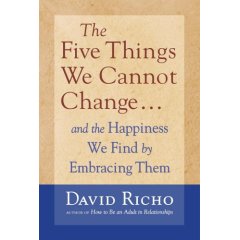
I want to recommend a book that I talked about in the ongoing classes this week. It's called The Five Things We Cannot Change... by David Richo. Here's an excerpt from the description on Amazon:
There are certain facts of life that we cannot change—the unavoidable "givens" of human existence: (1) everything changes and ends, (2) things do not always go according to plan, (3) life is not always fair, (4) pain is a part of life, and (5) people are not loving and loyal all the time. Richo shows us that by dropping our deep-seated resistance to these givens, we can find liberation and discover the true richness that life has to offer. Blending Western psychology and Eastern spirituality, including practical exercises, Richo shows us how to open up to our lives—including to what is frightening, painful, or disappointing—and discover our greatest gifts.When you think about it, each of these five things is clearly observable. Richo says it is the ego that fights against these realities and tries to get around them. Learning to accept and also to appreciate each of these givens will truly liberate us. We can appreciate them by using the insight they give us to cultivate both courage and compassion.
UPDATE: Just found this and I think it's in keeping with the above:
If you can't solve it, it's not a problem--it's reality.
Tuesday, February 06, 2007
More on pain
I posted below about evidence that meditators feel less pain than non-meditators. I just came across an observation that explains why. This is from Broken Open: How Difficult Times Can Help Us Grow by Elizabeth Lesser:
Mindfulness meditation trains us to be less reactive to whatever it is in life that causes us suffering. It gives us an ability to experience our own pain without identifying fully with it, and therefore to be more free from it. Because of that experience during meditation, we begin to fear life's pain less, to contract around it less. We become more easygoing with ourselves. We still suffer, but with much less of the dramatic flair that only adds to our suffering and makes it overwhelming.
Reduce your pain
This morning I came across a little column by a doctor that reported the following:
MRI, as some of you may know, is a noninvasive imaging test that uses magnetic energy to take three-dimensional pictures of internal body organs. "Functional" MRI is a new application of MRI, in which you can see how blood flow to the brain changes as you think; it is a way to monitor brain activity.40 to 50 percent. That's a lot. If that's not a good motivation to practice, I don't know what is!
In the research study, when 12 people who were skilled at meditation were examined using functional MRI, they had a 40 to 50 percent lower brain response to pain than 12 people who had never done meditation.
Monday, February 05, 2007
Time for meditation
I came across the following story this morning:
And that is true. As many of you know, I used to work for Desmond Tutu when he was Archbishop of Cape Town. I never met a busier person. And yet he never missed his hour of meditation in the morning. He almost always got to chapel before I did each morning! Then we would simply sit in silence together until it was time for community prayers. He is a man of great passion but also of great equanimity. And he never skipped his daily meditation because he was "too busy".A story has been told about a businessman and a bishop. The businessman approached the saintly bishop and inquired, "What is the secret of your being able to accomplish so much each day and with such a spirit of serenity?"
The good bishop answered, "My friend, add to each morning's prayer at least half an hour more of meditation and not only will you be able to accomplish peacefully all that needs to be done for the day but you will even find extra time for other things."
Sunday, February 04, 2007
It's for busy people
 Ven. Ajahn Brahmavamso
Here's an article about a meditation teacher in Australia named Ajahn Brahmavamso. Take a look at this excerpt:
With so much of talk about everyone being busy, Ajahn Brahm insisted that meditation is ideal for busy people. “Even if you are a busy person, it is more important to be able to spend some time being peaceful. If you don't learn how to be peaceful, you soon get very, very tired.”Meditation really does rest the mind if you do it correctly - that is, without strain or inner tension. It's a false economy indeed to "save time" by not meditating because meditation makes you more effective and efficient so that the time you have is put to better use.
To explain how meditation helps you, he used a simple exercise lifting the half-filled glass of water he had in front of him. "Say I am lifting up this glass of water and you ask me how heavy it is. If I keep holding the glass of water for five minutes, it appears quite heavy. If I continue to hold the glass for half an hour, I will be in quite a lot of pain. If I keep on holding it for two hours, I would be a stupid monk. When it starts to get heavy, what should I do? Put it down — let it go. I don't need to throw the glass of water away — I just put it down for, may be for 20 seconds. When I pick it up again, it feels lighter because I have rested.
“The problem of stress in our modern world is not because we do too much — it's because we don't know how to put our burdens, our responsibilities down for a few minutes and rest and relax. All we need to do is to rest for 15 or 20 minutes in meditation and afterwards we find ourselves so relaxed, we can carry the burdens of life without so much stress. That is what meditation is — learning how to relax so that you can do more with less stress,” he said.
Saturday, February 03, 2007
Friday, February 02, 2007
 From 1000 Pictures
True wisdom
Oh, I like this:
To be interested in the changing seasons is a happier state of mind than to be hopelessly in love with spring.
Thursday, February 01, 2007
Valuing those we meet
What would happen if you made a practice of valuing every person you meet? You would open yourself up to unexpected enlightenment, wouldn't you? Unexpected Enlightenment is the title of a little article that I want to recommend today. Here's an excerpt:
Our individual journeys take us into many unexpected situations where we encounter a wide variety of people-some quite like ourselves and some very different. We cannot anticipate these meetings, but we can make the most of them when they take place. When we are courteous as a matter of course and open-minded in our assessment of the individuals whose lives briefly touch our own, we are more apt to stumble upon surprising gems of wisdom that open our eyes to new worlds of possibility. Every person we meet can affect us profoundly, just as every situation we find ourselves in can teach us something new.It's easy to go through the day taking people for granted. Simply paying attention is the key to interrupting that habitual tendency. Opportunities are all around us. We simply need to open our eyes - and our hearts.
...
When we are cognizant of the potential for unexpected enlightenment, we make a habit of turning strangers into friends, thus ensuring that we are never without a font of wisdom from which to draw.
Subscribe to:
Posts (Atom)
