Wednesday, September 28, 2005

The value of renunciation

In the ongoing classes at the Center this week we have been discussing the topic of "renunciation" as an aspect of "right effort". I thought I'd share with you a wonderful paragraph from Awakening the Buddha Within by Lama Surya Das:

Renunciation refers to opening the tight fist of grasping and relinquishing our weighty burden of accumulated excess baggage. The heart of renunciation implies allowing rather than controlling. It requires letting go of that which is negative and harmful while opening up to sanity and wholeness. The question is: Can we let go of holding back? Can we relinquish our fears and defenses? Can we forgive? Can we surrender and learn to better accept things as they are? Typically, this is accomplished in small gradual steps. We grow up, and we adopt a more mature attitude. When we do this, we leave the homeland of our childhood. We give up our childish ways. We depart from the nest of our family of origin and free ourselves from frozen behaviors. We stop telling ourselves stories; we stop spinning fantasies. We're all carting heavy baggage that is not helping us get where we want to go or do what we want to do. Once we realize that we no longer need this baggage, we can relinquish it: once we have inner certainty, we can leave our old habits and negativities behind.

The inner certainty I believe he is talking about is the certainty - the deep conviction - that the way of compassion and staying in the moment is actually in our best interests. So a healthy renunciation is not about deprivation; it is about true freedom.

Tuesday, September 27, 2005

The duty to be happy

Every day at St. John's Center, we pray for all beings to be happy and create the causes for happiness. Have you ever stopped to think how happiness is actually a duty? It is really. Because unhappy people tend to cause other people to be unhappy too. So we do real harm in the world by being unhappy. Helen Keller is someone who understood this. Here is something she said:
Let pessimism once take hold of the mind, and life is all topsy-turvy, all vanity and vexation of spirit. There is no cure for individual or social disorder, except in forgetfulness and annihilation. "Let us eat, drink and be merry," says the pessimist, "for to-morrow we die." If I regarded my life from the point of view of the pessimist, I should be undone. I should seek in vain for the light that does not visit my eyes and the music that does not ring in my ears. I should beg night and day and never be satisfied. I should sit apart in awful solitude, a prey to fear and despair. But since I consider it a duty to myself and to others to be happy, I escape a misery worse than any physical deprivation.

Don't ever think that happiness is a matter simply of chance. We can take definite steps to cultivate happiness. A firm decision not to entertain resentment is undoubtedly key. Personally, I tell myself that I simply cannot afford it. It really doesn't matter whether the resentment can be justified or not. Please don't get into that debate because resentment will find a way to win every time. Realize, rather, that it will assuredly rob you of your happiness. It will. Oh yes, it will. And I would rather be happy any day.

Here's something else that Helen Keller said:
Many persons have a wrong idea of what constitutes true happiness. It is not attained through self-gratification but through fidelity to a worthy purpose.
For me that worthy purpose is applying the meditative principles to the way I work with my own mind and also helping other people to do the same. Everyone can have the application of meditative principles as his or her worthy purpose because we can apply them all day, every day no matter what our life's work happens to be.

Monday, September 26, 2005

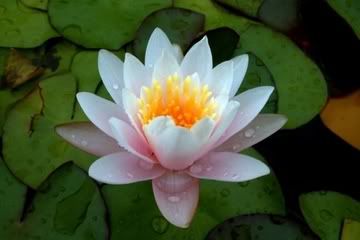
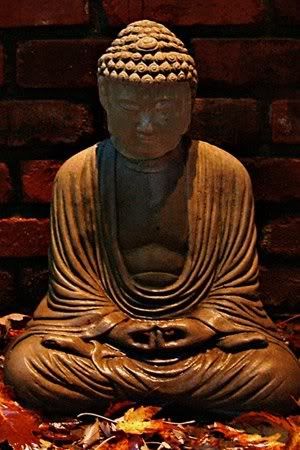
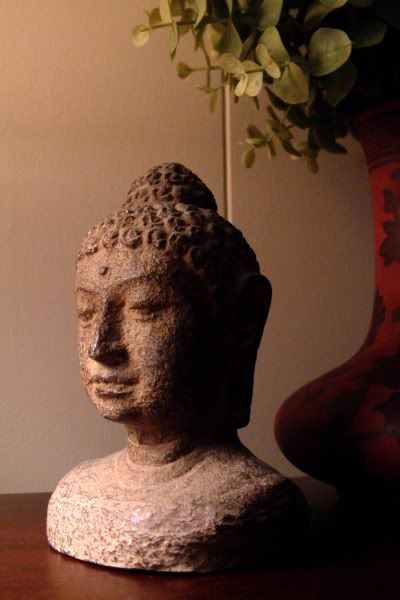
Monday Meditative Picture Blogging

Image hosted by Photobucket.com
Photo by Cynthia Burgess

Celebrating the Now

Paul Rogers sent me this marvelous poem by David Budbill:

This Shining Moment in the Now

When I work outdoors all day, every day, as I do now, in the fall, getting ready for winter, tearing up the garden, digging potatoes, gathering the squash, cutting firewood, making kindling, repairing bridges over the brook, clearing trails in the woods, doing the last of the fall mowing, pruning apple trees, taking down the screens, putting up the storm windows, banking the house—all these things, as preparation for the coming cold...

when I am every day all day all body and no mind, when I am physically, wholly and completely, in this world with the birds, the deer, the sky, the wind, the trees...

when day after day I think of nothing but what the next chore is, when I go from clearing woods roads, to sharpening a chain saw, to changing the oil in a mower, to stacking wood, when I amall body and no mind...

when I am only here and now and nowhere else—then, and only then, do I see the crippling power of mind, the curse of thought, and I pause and wonder why I so seldom find this shining moment in the now.

Of course, I would hasten to remind everybody that a thought is only a curse when we don't know what to do with it. As meditators we know that when thought arises we can accept it without judgment, let it go, and then return to the meditative support. That will bring us just as reliably to "this shining moment in the now" as the wonderful activities celebrated by the poet.

Sunday, September 25, 2005

Give peace a chance

Yesterday there was a massive anti-war protest in Washington, D.C. I've blogged about that on Child of Illusion if you want a full report. What I want to share with you here is a quote from the original Star Trek series. Here it is:

"[War] is instinctive. But the instinct can be fought. We're human beings with the blood of a million savage years on our hands! But we can stop it. We can admit that we're killers ... but we're not going to kill today. That's all it takes! Knowing that we're not going to kill today!"

-- Kirk, "Arena", stardate 3193.0


This is the very basis of all 12-Step programs. A person will be overwhelmed by the prospect of giving up something for life. But for one day? Anybody can refrain from a given behavior for a day. So "one day at a time" is the quintessential slogan.

Why don't we all choose to be in solidarity with the anti-war protesters by deciding not to give energy to judgmental, blaming, resentful thoughts just for today. I will not blame today. That's all it takes! Knowing that we're not going to blame today.

Because peace begins in the heart, in the mind. Be the peace you want to see.

Saturday, September 24, 2005

Courage to change

If we don't change, we don't grow. If we don't grow, we are not really living. Growth demands a temporary surrender of security.

If you are irritated by every rub, how will you be polished?

Friday, September 23, 2005

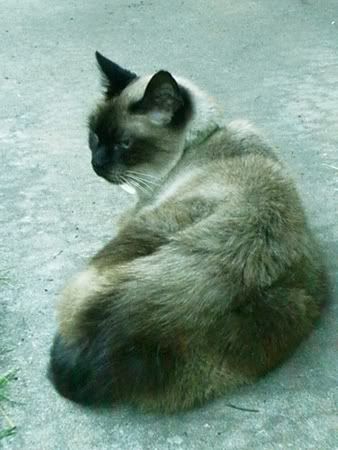
Friday Cat Blogging!

Nap time for Henry!

Image hosted by Photobucket.com
Photo by Ellie Finlay

True happiness

Happiness cannot come from hatred or anger. Nobody can say, "Today I am happy because this morning I was very angry." On the contrary, people feel uneasy and sad and say, "Today I am not happy because I lost my temper this morning." Through kindness, whether at our own level or at the national and international level, through mutual understanding and through mutual respect, we will get peace, we will get happiness, and we will get genuine satisfaction.

- the Dalai Lama

Thursday, September 22, 2005

Relaxation exercise

Sometimes people experience so much agitation from the day's activities that it's hard to settle down in order to meditate. A simple relaxation exercise is offered in Naomi Ozaniec's Meditation for Beginners:
Relaxation should be done slowly. The mind is simply focused on the different body parts in turn in the following way: turn your attention inwards and mentally repeat the phrase to yourself. After each phrase you should also experience a release of tension in the body itself. Take your time with this exercise.

The top of my head is relaxing; I feel relaxed.
My face feels relaxed; I am relaxed.
My shoulders and chest feel relaxed; I am relaxing.
My arms and hands feel relaxed; I am relaxing.
My legs and feet feel relaxed; I am relaxing.
I am relaxed. My mind is calm. My body is calm.
I am relaxed. My mind is alert. My mind is awake.
The idea is not to space out but to come to a state of relaxed alertness. Try this exercise the next time you feel tense. You can do it at the computer while reading the instructions off the monitor as a little meditation break in the middle of your work. Then when you have it memorized you can do it anytime, anywhere.

Wednesday, September 21, 2005

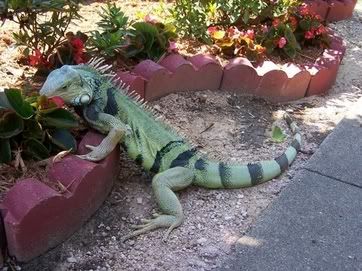
Wednesday life form blogging

Image hosted by Photobucket.com
Photo by Cynthia Burgess

Finding your space

Here is still another passage from Meditation for Beginners by Naomi Ozaniec on inner spaciousness:

The first step in meditation involves looking into the mind and its busy contents. When we become conscious of space within our minds, we will find that we have made room for thoughts and realizations of a new order to be born. Creativity, insight and intuition can only come into being when there is space for us to be receptive to the still small voice of inspiration.

Awaken yourself to the extraordinary mystery of space. Go out and observe the night sky and meditate on what you see. Become aware of immensities beyond measure. Consciously seeking your space will eventually enable you to find your space as part of the heavens here on earth.

What she's talking about is a connection with the whole universe. Meditation exposes the illusion of separation and helps us recognize the connection that is real.

Tuesday, September 20, 2005

More on inner spaciousness

Here's another passage from Meditation for Beginners by Naomi Ozaniec:

Our minds, like our lives, teem with plans, memories, ideas, words and thoughts. We become so used to this state of being that in time we don't even notice it. The rushing stream of consciousness, thoughts mainly without purpose and idle chatter, is ever present like an internal white noise. Everything is hurried, all mental space is filled. It is only when we take the trouble to observe the process that we can evaluate its effect upon us. A mind that is full is like an untidy cupboard that spills its contents whenever the door is opened. It has no space for insight, creativity or applied thought.

In one way, we create space by meditating. In another way, we don't have to create it at all; it is already there. All we need to do is notice the space that is naturally present - and keep noticing it.

Monday, September 19, 2005

Global consciousness

Here's a passage from a marvelous little book called Meditation for Beginners by Naomi Ozaniec:

Meditation may appear to be a solitary pursuit even when it is performed in groups. However, far from being an isolating or self-centered activity, meditation brings expansion and connection to others. Meditation inescapably brings the world into your heart. Meditators have always known this.

We live upon one world and breathe one air, yet we consciously divide all that we have into "mine" and "not mine". We are convinced by the illusion of separation. We are steadfastly wedded to territorial principles. Global consciousness, on the other hand, unites where we choose to divide, connects where we choose to isolate and unifies where we choose to fragment.

Mystics through the ages have recorded the personal experience of unity and affirmed the wholeness of all creation. Such individuals were not informed by global communication or holistic philosophy. Yet testaments of mystical experience from all traditions and times tell us what we have only recently come to know, that Life is a Unity which takes on the appearance of a myriad of forms.

It's true. The more we meditate, the more connected we feel and the less isolated. You don't have to be a mystic to have this experience. Just the practice of letting go of judgments during meditation will increase a sense of unity with others and with the universe.

Sunday, September 18, 2005

Values

“Fame or integrity: which is more important? Money or happiness: which is more valuable? Success or failure: which is more destructive? If you look to others for fulfillment, you will never truly be fulfilled. If your happiness depends on money, you will never be happy with yourself. Be content with what you have; rejoice in the way things are. When you realize there is nothing lacking, the whole world belongs to you.”

6th century BCE Chinese philosopher, founder of Taoism

Saturday, September 17, 2005

Something to ponder

“The opposite of a correct statement is a false statement. The opposite of a profound truth may well be another profound truth.”

Friday, September 16, 2005

Friday Cat Blogging!

Paul Rogers sent in the following photo with this note:

This is Scarlet who lives down the street. She is 14 years old and we feed her when her 'mom' is out of town.
Paul


Image hosted by Photobucket.com

The importance of self-awareness

“People travel to wonder at the height of mountains, at the huge waves of the sea, at the long courses of rivers, at the vast compass of the ocean, at the circular motion of the stars; and they pass by themselves without wondering.”

-- St. Augustine

Regular meditation along with diligent study of the meditative tradition and teachings comprise the vehicle for cultivating self-awareness. Let us take time to wonder at ourselves and exert right effort in doing so.

Thursday, September 15, 2005

The spam problem

I think I should tell you that the people who send out spam have now found blogs and have started sending advertisements and other commercial messages to blog comments sections. So whenever you see that I have removed a comment, that is the reason. I would not remove a bona fide comment about a posting unless it contained racist remarks or other hate messages or incitement to violence. Please feel very free to express your opinion at any time!

More on spaciousness

I want to share with you a bit more of what John Welwood has to say about the role of space in letting go of old ego-clinging. This is from his book, Toward a Psychology of Awakening:

Whenever we allow ourselves to experience some difficult feeling, or whenever an old identity starts to loosen up, the larger space of being that this feeling or identity had been obscuring starts to be revealed. This is a challenging moment, because it can often feel as though we are falling through space. If we resist space at this point, the falling becomes terrifying, and we may try to abort the experience, "pulling ourselves together" by contracting and tensing. This prevents us from freeing ourselves from the old fixation that was starting to dissolve.

Yet if we can learn to relax into the expansiveness that is opening up, then we may begin to discover space as support: The ground of our being actually hold us up. We may feel extremely light at the same time, as though we are floating on a bed of clouds. Once we have made this discovery, the shedding of old identities becomes far less frightening.

This is where the role of "right effort" comes into play. Courage is actually an aspect of right effort. What I want to emphasize here is that it's normal for courage to be required for deep inner work. Take heart and don't give up, no matter how strange it may feel to start becoming aware on an interior level.

Wednesday, September 14, 2005

Wednesday life form blogging

Image hosted by Photobucket.com
Photo by Cynthia Burgess

Healing and spaciousness

Often when we have emotional or psychological difficulties, our impulse is to try to fix things, to engage in a self-improvement campaign, to engineer results. And that can cause a certain tension in our attitude towards ourselves. John Welwood, in his book Toward a Psychology of Awakening, insists, rather, that a spacious approach is needed:

Psychological problems move in the direction of healing only when we can relate to them in a spacious way, from the space of our being. When we try to fix our problems directly, we usually pit one side of ourselves against another, and this creates inner pressure and stress - which only contract our space. This is what our mind is like most of the time - a crowded, narrow thoroughfare that is choked with traffic trying to move in different directions. One thought moves in one direction, and other thoughts move against it. ("I'm angry" - "I shouldn't be angry" - "Why shouldn't I be angry?" - "But what will people think?") These inner oppositions create a traffic jam and shut down the space. When we can give our experience space in which to be, with awareness, the jam in our mind starts to clear up and the traffic has room to move freely once again. We may not have fixed the problem, but we have found a larger space in which to hold the problems. This is how true healing occurs.

Meditation is the method by which we learn to access that inner spaciousness. This is why regular practice is so important. It is also why we need to be gentle and relaxed in our daily practice and not slip into a forced, harsh way of working with ourselves. Try using the word "spaciousness" as a mantra for a few minutes and see how open and relaxed you feel as a result!

Tuesday, September 13, 2005

The ego and emotions

Often people believe that spiritual advancement means being in control of one's emotions - particularly if they are disturbing emotions. Nothing could be further from the truth. What we need to practice is the willingness to accept our difficult emotions without judgment but to choose not to feed them, not to give them extra energy. John Welwood speaks to this in his book, Toward a Psychology of Awakening:

If ego is the tendency to hold on to ourselves and control our experience, then feeling our emotions directly and letting their energy flow freely threatens ego's whole control structure. When we open to the actual texture and quality of a feeling, instead of trying to control or judge it, "I" - the activity of trying to hold ourselves together - starts to dissolve into "it" - the larger aliveness present in the feeling. If I fully open to my sorrow, it may intensify for a while, and I may feel all the grief of it. Yet opening to this pain, without stories, also makes me feel more alive. As I turn to face my demons, they reveal themselves as my very own life energy.

Emotions, we could say, are the blood shed by ego - they start to flow whenever we are touched, whenever the defensive shell around the heart is pierced. Trying to control them is an attempt to keep this shell from cracking. Letting ego bleed, on the other hand, opens the heart. Then we rediscover ourselves as living beings who are exposed to the world, interconnected with all other beings. Letting go of judgments and story lines and feeling this naked quality of being alive wakes us up and nurtures compassion for ourselves and others.

So accept whatever you're feeling. Don't judge it by either condemning it or justifying it. Also don't assume that you have to act on it. Let the feeling just be itself. Then remember impermanence. The feeling will dissolve according to its own time table.

Monday, September 12, 2005

Monday Meditative Picture Blogging

Image hosted by Photobucket.com
Photo by Cynthia Burgess

Relax!

Meditation is not meant to be stressful or forced. Bhante Henepola Gunaratana explains this in his book, Mindfulness in Plain English:

Don't strain. Don't force anything or make grand, exaggerated efforts. Meditation is not aggressive. There is no place or need for violent striving. Just let your effort be relaxed and steady.

Sometimes people scold themselves in meditation when their minds wander. Be sure not to do this! Have a gentle interior tone of voice with yourself. Meditation is not a contest with distractions. Rather it is a way of deeply resting the mind.

Sunday, September 11, 2005

The reality of change

Certainly we have had a profound lesson in impermanence over the past two weeks. Here is an observation about change by Dan Millman in The Way of the Peaceful Warrior:

If you don't get what you want, you suffer; if you get what you don't want, you suffer; even when you get exactly what you want, you still suffer because you can't hold on to it forever. Your mind is your predicament. It wants to be free of change. Free of pain, free of the obligations of life and death. But change is a law, and no amount of pretending will alter that reality.

Regularly reflecting on the reality of change, of impermanence, will help us accept unwanted change when it comes. Resisting change will cause suffering - sometimes great suffering. Letting go of that resistance is truly the skillful way forward.

Saturday, September 10, 2005

The greatest gift

This quote by David R. Hawkins captures, I think, what we're here for:

Make a gift of your life and lift all mankind by being kind, considerate, forgiving, and compassionate at all times, in all places, and under all conditions, with everyone as well as yourself. This is the greatest gift anyone can give.

What would happen if we all did this? What would happen if just a few people did this - really did it? If you want to make a difference in the world, this is how.

Friday, September 09, 2005

Friday Cat Blogging!

This little kitten belongs to Cynthia's friend, Sandy.

Image hosted by Photobucket.com
Photo by Cynthia Burgess

Clean your window

Here's a very penetrating little story as told by Anthony de Mello in The Heart of the Enlightened:
A woman complained to a visiting friend that her neighbor was a poor housekeeper. "You should see how dirty her children are - and her house. It is almost a disgrace to be living in the same neighborhood as her. Take a look at those clothes she has hung out on the line. See the black streaks on the sheets and towels!"

The friend walked up to the window and said, "I think the clothes are quite clean, my dear. The streaks are on your window."

Ah. We tend to judge others by ourselves, don't we? Meditation is the way to clean our own window so that we see clearly.

Thursday, September 08, 2005

By Mother Teresa

People are often unreasonable, illogical, and self-centered;
...Forgive them anyway.

If you are kind, people may accuse you of selfish, ulterior motives;
...Be kind anyway.

If you are successful, you will win some false friends and some true enemies;
...Succeed anyway.

If you are honest and frank, people may cheat you;
...Be honest and frank anyway.

What you spend years building, someone could destroy overnight;
...Build anyway.

If you find serenity and happiness, they may be jealous;
...Be happy anyway.

The good you do today, people will often forget tomorrow;
...Do good anyway.

Give the world the best you have, and it may never be enough;
...Give the world the best you've got anyway.

You see, in the final analysis, it is between you and God;
It was never between you and them anyway.

Wednesday, September 07, 2005

What needs to be done

Sometimes people get discouraged after doing a certain amount of inner work because they see the obstacles within to freedom more clearly than they did before beginning such work. Dan Millman speaks to that:

A flash of enlightenment offers a preview of coming attractions, but when it fades, you will see more clearly what separates you from that state -- your compulsive habits, outmoded beliefs, false associations, and other mental structures. Just when our lives are starting to get better, we may feel like things are getting worse - because for the first time we see clearly what needs to be done.

Here's where we need to remember that the journey of a thousand miles begins with the first step. Freedom is waiting for us if we only persevere.

Tuesday, September 06, 2005

Humility

Here's a really good story from One Minute Wisdom by Anthony de Mello:

To a visitor who described himself as a seeker after Truth the Master said, "If what you seek is Truth, there is one thing you must have above all else."

"I know. An overwhelming passion for it."

"No. An unremitting readiness to admit you may be wrong."

It seems so obvious, doesn't it? But it's so very hard for many people. Think about it, though. Don't we experience it as being very unattractive when other people can't admit they're wrong? So it is appropriate to cultivate that ability in ourselves. It's really a relief when we do so.

Monday, September 05, 2005

Staying centered

How can we cope - emotionally, psychologically, spiritually - with the awareness of so much suffering being experienced on the Gulf Coast right now? Here's a wonderful quote by Krishnamurti that tells us how:
It is a great art to have an abundance of knowledge and experience - to know the richness of life, the beauty of existence, the struggles, the miseries, the laughter, the tears - and yet keep your mind very simple; and you can have a simple mind only when you know how to love.

Let us keep our mind simple. And simply be willing to send love to all beings who are suffering right now. Love in action, of course, means sending contributions to the relief effort and may well involve volunteering our time and effort if evacuees come to our community. But whatever we do, let us keep our mind simple.

Sunday, September 04, 2005

The Master's wisdom

Here's another little story told by Anthony de Mello in One Minute Wisdom:

A writer arrive at the monastery to write a book about the Master.

"People say you are a genius. Are you?" he asked.

"You might way so," said the Master, none too modestly.

"And what makes one a genius?"

"The ability to recognize."

"Recognize what?"

"The butterfly in a caterpillar; the eagle in an egg; the saint in a selfish human being."

My own spiritual director of many years standing is like that. He is able to see the illuminated, enlightened, resurrected reality of the person sitting before him - no matter how troubled or messed up that person is at the time. It is a very great gift and one we would all do well to cultivate.

Saturday, September 03, 2005

Sending and taking

Yesterday, I mentioned the importance of doing Tonglen and Metta practices for the victims of Hurricane Katrina and for the rescue workers as well. Today I want to remind you about how to do these practices.

For Tonglen you visualize or just bring to mind the person or beings of your intention. Then when you breathe in, you take their suffering off of them and bring it into yourself. It is then transformed because when you breathe out you send them happiness and well being and relief from suffering. You do not have to feel any particular way for this practice to be effective. What matters is your intention.

Metta or lovingkindness is a sending practice. I use the sentence, "May they be happy; may they be well; may everything be well in their lives."

Be sure and start each practice by giving yourself compassion and lovingkindness. Then you can share it with all beings everywhere. Focusing on a particular group or individual is completely appropriate.

Another important focus is to do the practices for other people just like you who have the same feelings of distress you have about the disaster. It's sometimes easier to get started this way that to try to focus on the victims right away.

Tonglen and Metta are not substitutes for action. They are the context and the ground for action. They keep us from desensitizing ourselves and from giving up. They stir the inner potential for deep caring and motivate us to give blood, to give money, to volunteer in whatever way we can. Do make these practices part of your daily discipline as more and more news reaches you about the devastating effects of the disaster before us.

Friday, September 02, 2005

Friday Cat Blogging!

It's time to feature Cynthia's cat, Simon, again!

Image hosted by Photobucket.com
Photo by Cynthia Burgess

The devastation

As the situation in New Orleans worsens I can only today ask you to do Tonglen (compassion) practice and Metta (lovingkindness) practice for the victims and rescue workers. The situation is simply beyond horrible and the suffering defies description.

Please do what you can to help. Right now, what most of us can do is donate blood and money to the Red Cross or other relief organizations. I also want to call your attention to Noah's Wish, an animal disaster relief agency. Yesterday I read the following quote from an AP article on one of the blogs I frequent:

Many people had dogs and they cannot take them on the bus. A police officer took one from a little boy, who cried until he vomited. "Snowball, snowball," he cried. The policeman told a reporter he didn't know what would happen to the dog.

I would do the same thing. I'm sure I would cry until I vomited if one of my animals were turned away. I simply do not think I could leave them.

How horrible for people to have managed to rescue their dogs for so many days only to have them turned away on the evacuation bus. And what is to happen to those animals that are just turned loose? Please give to Noah's Wish and/or PETA who are both engaged in animal relief efforts right now. PETA sent out a message yesterday saying that they had worked hard to give people instructions before Katrina hit on how to evacuate their animals. But there are many people who just abandoned their animals or whose animals were refused shelter or transportation. The suffering of both humans and animals is beyond anything we can imagine. But the animals don't understand what is happening. Please help.

If you want to give money to help humans, may I recommend Episcopal Relief and Development. They are launching a full scale, multi-state response to the disaster. You can earmark your donation for Hurricane Katrina relief.

Thursday, September 01, 2005

Action and inaction

Here is another brief conversation between the Master and his disciple as told by Anthony de Mello in One Minute Wisdom:
"What is the highest act a person can perform?"

"Sitting in meditation."

"Wouldn't that lead to inaction?"

"It is inaction."

"Is action, then, inferior?"

"Inaction gives life to actions. Without it they are dead."

Meditation grounds us, stabilizes us and trains us to perform our actions skillfully and with compassion.

Wednesday, August 31, 2005

Wednesday life form blogging

Image hosted by Photobucket.com
Photo by Cynthia Burgess

The problem with goals

Here is a little story as told by Anthony de Mello in One Minute Wisdom:

The Master said, "It is, alas, easier to travel than to stop."

The disciples demanded to know why.

"Because as long as you travel to a goal, you can hold on to a dream. When you stop, you face reality."

"How shall we ever change if we have no goals or dreams?" asked the mystified disciples.

"Change that is real is change that is not willed. Face reality and unwilled change will happen."

The master is talking about the mind poison of delusion, isn't he? That is what we need to stop. Remember that meditation - mindfulness - is knowing what's happening while it's happening no matter what it is. Delusion makes this impossible. What we need to stop is our compulsion to feed delusion. Let go of the need to live in a fantasy. Just stop.

Tuesday, August 30, 2005

Happiness

A psychologically healthy person can, in fact, be defined as someone whose desires actually produce happiness.


-- Deepak Chopra

Monday, August 29, 2005

Monday Meditative Picture Blogging

Image hosted by Photobucket.com
Photo by Cynthia Burgess
This morning I discovered a passage from Be an Island: The Buddhist Practice of Inner Peace by Ayya Khema, a Theravadan nun. Here it is:

The greatest support we can have is mindfulness, which means being totally present in each moment. If the mind remains centered, it cannot make up stories about the injustice of the world or one's friends, or about one's desires or sorrows. All these stories could fill many volumes, but when we are mindful such verbalizations stop. Being mindful means being fully absorbed in the moment, leaving no room for anything else. We are filled with the momentary happening, whatever it is--standing or sitting or lying down, feeling pleasure or pain--and we maintain a nonjudgmental awareness, a "just knowing."

Great suffering is often created by making up stories about injustice. If mindfulness will prevent this, then mindfulness will truly alleviate the suffering we cause ourselves. The decision not to indulge ourselves with such stories is a decision that will powerfully help us on our way to maturity in our meditative practice.

Sunday, August 28, 2005

Compassion for all beings

It's a simple little story found in Anthony de Mello's The Heart of the Enlightened but it aptly illustrates what happens when we are concerned only for ourselves:

There was once a man who was busy building a home for himself. He wanted it to be the nicest, cosiest home in the world.

Someone came to him to ask for help because the world was on fire. But it was his home he was interested in, not the world.

When he finally finished his home, he found he did not have a planet to put it on.

Care for yourself, care for other people, care for other animals, care for the planet. All are fitting and necessary for without such care we will not have a planet that will support our lives.

Saturday, August 27, 2005

The ocean of awareness

Here's another paragraph from John Welwood's Toward a Psychology of Awakening. I selected this passage simply because I found it so inspiring.

Meditation is designed to help us move beyond the surface contents of the mind. Underneath the mind's surface activity - the vivid whitecaps of thought and emotion as well as the subtler flows of felt sensing - the ocean of awareness remains perfectly at rest, regardless of what is happening on its surface. As long as we are caught up in the waves of thought and feeling, they appear solid and overwhelming. But if we can find the presence of awareness within our thoughts and feelings, they lose their formal solidity and release their fixations. In the words of the Tibetan teacher Tarthang Tulku, "Stay in the thoughts. Just be there...You become the center of the thought. But there is not really any center... Yet at the same time, there is...complete openness.... If we can do this, any thought becomes meditation." In this way, meditation reveals the absolute stillness within both the mind's turbulence and its relative calm.

I find it very encouraging to realize that even when I'm not in formal meditation sitting, I can use whatever my mind needs to be thinking about as meditation if I simply stay in the thought and be there. Also please notice that we don't have to create the calm. It is there all the time. It is found within the "ocean of awareness" that we all have even if we're not awake to its reality. So, once again, the teaching is to wake up!

Friday, August 26, 2005

Friday Cat Blogging!

Here's Edgar stretched out looking like a lion.

Image hosted by Photobucket.com
Photo by Ellie Finlay

What kind of bones?

Here's one of my favorite stories from The Heart of the Enlightened by Anthony de Mello:

Plutarch tells the story of how Alexander the Great came upon Diogenes looking attentively at a heap of human bones.

"What are you looking for?" asked Alexander.

"Something I cannot find," said the philosopher.

"And what is that?"

"The difference between your father's bones and those of his slaves."

De Mello then makes this comment:

The following are just as indistinguishable: Catholic bones from Protestant bones, Hindu from Muslim bones, Arab bones from Israeli bones, Russian bones from American bones.

The enlightened fail to see the difference even when the bones are clothed in flesh.

I would add that there is no difference between American bones and Iraqi bones.

One of the most important awarenesses that I've had in my journey is that we are all more alike than we are different and that my job is to look for similarities, not differences. If I look hard enough, if I am willing enough, I see that each being's reality is somehow my reality as well. After all, all beings want to be happy and to be free from suffering. People do what they do because on some level they think what they do will make them happy. They may be very mistaken at times but that's the universal motivation. And since I, too, want to be happy, I have something profoundly in common with everyone.

Thursday, August 25, 2005

The tyranny of the idealized self

Here's another passage by John Welwood from his really marvelous book, Toward a Psychology of Awakening:

The continual activity of grasping onto an ego identity is essentially narcissistic, for it keeps us occupied with propping up an image of ourselves. Even Freud recognized the narcissism inherent in the ego when he wrote, "The development of the ego consists in a departure from primal narcissism and results in a vigorous attempt to recover it." So if we truly want to move beyond narcissistic self-involvement, we must work on overcoming our identification with whatever we imagine ourselves to be - any image of ourselves as something solid, separate, or defined. The less involved we are with images of who we are, the more we will be able to recognize our deep bond with all sentient beings, as different expressions of the mystery that also pervades our inmost nature.

Our true, deep nature is so much richer, so much more free than our ego can ever be! But if our objective is constantly that of propping up the ego, we will never access that inmost part of our reality.

Wednesday, August 24, 2005

Wednesday life form blogging

Image hosted by Photobucket.com
Photo by Cynthia Burgess

Let go of the outcome

It's the action, not the fruit of the action,that's important. You have to do the right thing. It may not be in your power, may not be in your time, that there'll be any fruit. But that doesn't mean you stop doing the right thing. You may never know what results come from your action. But if you do nothing, there will be no result.
-- Gandhi

Tuesday, August 23, 2005

The courage to stop

There comes a time when the pain of continuing exceeds the pain of stopping. At that moment, a threshold is crossed. What seemed unthinkable becomes thinkable. Slowly, the realization emerges that the choice to continue what you have been doing is the choice to live in discomfort, and the choice to stop what you have been doing is the choice to breathe deeply and freely again. Once that realization has emerged, you can either honor it or ignore it, but you cannot forget it. What has become known can not become unknown again.
-- Gary Zukav

Monday, August 22, 2005

Monday Meditative Picture Blogging

Image hosted by Photobucket.com
Photo by Cynthia Burgess

Falling apart gracefully

One of the most skillful and compassionate things we can do for ourselves in our meditative practice is to let go and allow our artificial "self" to be dismantled by the process so that we can see through the sham and the ego-clinging that have been built up over the years. John Welwood speaks to this in his book, Toward a Psychology of Awakening. Here's an excerpt:

Many of us recognize that life is a continual process of moving forward, and that it's impossible to move gracefully through life unless we can let go of where we have already been. Though we may know this rationally, it is still hard to let go, and still painful when old structures collapse on their own, without consulting us first. The crumbling of our own identity right before our eyes is especially painful. Yet since life is continual flux, this means that we must be prepared to go through a series of identity crises. Especially in this era of advanced future shock, when the meanings holding people's lives together erode ever more rapidly, identity crises inevitably escalate at an ever-increasing rate.

Meditation is a way of learning to accept and welcome this, by letting go and falling apart gracefully. As we sit, we can see that most of our thoughts are about ourselves; in face, they are our way of trying to keep ourselves together from moment to moment. When we no longer reinforce these thoughts, the self we've been trying to hold together in a nice, neat package begins unraveling right before our eyes. As soon as we stop trying to glue it together, it quickly comes unglued. This allows us to see how we are constructing and maintaining it, and how that causes endless tension and stress.

I realize there is often a lot of fear associated with letting go of the constructed, held-together self. What I want to say by way of reassurance here is that it is completely safe. Nothing bad will happen. In fact, what you will experience is relief and freedom. Think how wonderful it would be if you didn't have to keep propping yourself up all the time. You don't have to. You can just let go and be the stream of consciousness that you are: happy, joyous and free.

Sunday, August 21, 2005

A picture of true freedom

Here's a marvelous little story as told by Anthony de Mello in The Heart of the Enlightened:

A King ran into a dervish, and in keeping with the custom of the East when a King met a subject, he said, "Ask for a favor."

The dervish replied, "It would be unseemly for me to ask a favor of one of my slaves."

"How dare you speak so disrespectfully to the King," said a guardsman. "Explain yourself or you shall die."

The dervish said, "I have a slave who is the master of your King."

"Who?"

"Fear," said the dervish.

Fearlessness is truly the greatest freedom. We can start by choosing to be unafraid of what we will find within when we do inner work. Regular meditation equips us for this work because we know what to do with any difficult material that comes up. We notice it, accept it without judgment, we let it go and we return to our meditative support. We can do this throughout our day by returning to the present moment and the task at hand. If we follow this practice, nothing can come up from within that will disturb us. Imprint this process on your consciousness: notice, accept, let go, return; notice, accept, let go return. Repeat it as a mantra and then apply it both in formal sitting and throughout your day. The resulting serenity is just amazing.

Saturday, August 20, 2005

Going forward

Paul Rogers sent me the following poem by Nan Cohen. I think it's quite wonderful and appropriate for reflection.

Girder

The simplest of bridges, a promise
that you will go forward,

that you can come back.
So you cross over.

It says you can come back.
So you go forward.

But even if you come back
then you must go forward.

I am always either going back
or coming forward. There is always

something I have to carry,
something I leave behind.

I am a figure in a logic problem,
standing on one shore

with the things I cannot leave,
looking across at what I cannot have.

Friday, August 19, 2005

Friday Cat Blogging!

Well, I can't let Friday go by without some cat blogging. Here's Simon, Cynthia's cat. And I'm finally feeling a bit better so I think I'll be back to my normal blogging routine soon! :-) Hope everybody's well and that you've been able to make do with archives here.

Image hosted by Photobucket.com
Photo by Cynthia Burgess

Wednesday, August 17, 2005

Under the weather

Sorry for the lack of posting the last couple of days. I've been ill and quite debilitated. I hope I'll be back to my regular routine in the next couple of days! Thank you for your patience!

Tuesday, August 16, 2005

More on basic goodness

It's so very important to make friends with the parts of ourselves we don't like. If we don't, if we try to get rid of those aspects of ourselves, we may actually end up being destructive toward something that is very valuable. John Welwood discusses this in his book, "Toward a Psychology of Awakening":

The poignant truth about human suffering is that all our neurotic self-destructive patterns are twisted forms of basic goodness, which lies hidden within them. For example, a little girl with an alcoholic father sees his unhappiness and wants to make him happy so that she can experience unconditional love - the love of being - flowing between them. Unfortunately, out of her desire to please him, she also winds up bending herself out of shape, disregarding her own needs and blaming herself for failing to make him happy. As a result, she ends up with a harsh inner critic and repeatedly reenacts a neurotic victim role with the men in her life. Although her fixation on trying to please is misguided, it originally arose out of a spark of generosity and caring for her father.

Just as muddy water contains clear water within it when the dirt settles out, all our negative tendencies reveal a spark of basic goodness and intelligence at their core, which is usually obscured by our habitual tendencies. Within our anger, for instance, there may be an arrow-like straightforwardness that can be a real gift when communicated without attack or blame. Our passivity may contain a capacity for acceptance and letting things be. And our self-hatred often contains a desire to destroy those elements of our personality that oppress us and prevent us from being fully ourselves. Since every negative or self-defeating behavior is but a distorted form of our larger intelligence, we don't have to struggle against this dirt that muddies the water of our being.

So don't struggle. Accept without judgment. Let go. Bring the mind back to the present moment. Meditate on impermanence and know that because of impermanence we can change. We are skillful in our efforts to change when we practice unconditional friendliness toward ourselves.

Monday, August 15, 2005

Mental distortions

All of us, I imagine, have a preference for congenial relationships. Given the choice, we would rather not have the challenge of coping with difficult people or people who actually wish to do us harm. But if we only have congenial interactions with others, we won't grow or truly understand ourselves. B. Alan Wallace makes this point in a passage from The Seven Point Mind Training:

Again and again, think of mental distortions as afflictions, contrary to nature. When someone is hot-tempered, narrow-minded, bigoted, selfish, or thoughtless, we think, "What a disgusting person!" But all these qualities are afflictions, and that person is the first to bear the initial brunt of suffering from them. The more repugnant a person is, the more likely that person is to be suffering from the mental distortions that render him or her repugnant to us.
...
Having engaged in... Mind Training, we can recognize that a person who has harmed us thereby kicks us out of our complacency and pushes us into practice. If we are surrounded by friends, our mental distortions may rarely be triggered and we can easily exaggerate our sense of the progress we have made in our practice. But when hostility triggers animosity, it is like a bucket full of cold water in the face, making it very clear that we have something here to work on.

My own meditation teacher used to say of any difficulty, "It's material; we can work with it." It is amazing how we can alleviate our own suffering by taking this approach -- by seeing challenges (no matter how negative or full of hostility) as material we can work with.

Sunday, August 14, 2005

Staying in the moment

Here's a great little story by Anthony de Mello in The Heart of the Enlightened:

The clock master was about to fix the pendulum of a clock when, to his surprise, he heard the pendulum speak.

"Please, sir, leave me alone," the pendulum pleaded. "It will be an act of kindness on your part. Think of the number of times I will have to tick day and night. So many times each minute, sixty minutes an hour, twenty-four hours a day, three hundred and sixty-five days a year. For year upon year... millions of ticks. I could never do it."

But the clock master answered wisely, "Don't think of the future. Just do one tick at a time and you will enjoy every tick for the rest of your life."

And that is exactly what the pendulum decided to do. It is still ticking merrily away.
It is simply magical what living in the moment will do for us in terms of happiness and the alleviation of suffering. One moment at a time. That is all.

Magical.

Saturday, August 13, 2005

Unconditional friendliness

One of the big misconceptions about meditation that beginners tend to have is the belief that one is supposed to force the mind to remain on the meditation support. John Welwood describes the correct approach in his book, Toward a Psychology of Awakening:

In meditation practice, you work directly with your confused mind-states, without waging crusades against any aspect of your experience. You let all your tendencies arise, without trying to screen anything out, manipulate experience in any way, or measure up to any ideal standard. Allowing yourself the space to be as you are - letting whatever arises arise, without fixation on it, and coming back to simple presence - this is perhaps the most loving and compassionate way you can treat yourself. It helps you make friends with the whole range of your experience.

As you simplify in this way, you start to feel your very presence as wholesome in and of itself. You don't have to prove that you are good. You discover a self-existing sanity that lies deeper than all thought or feeling. You appreciate the beauty of just being awake, responsive, and open to life. Appreciating this basic, underlying sense of goodness is the birth of maitri - unconditional friendliness toward yourself.

There is nothing more tragic than to be in an adversarial relationship with oneself and, sadly, this is true for many people. Cultivate "unconditional friendliness" toward yourself by practicing the spacious, open approach to meditation that Welwood describes. The benefit is, quite simply, the alleviation of suffering and the arising of true happiness.

Friday, August 12, 2005

Friday Cat Blogging!

It's Henry, the old man, looking a bit irritated! As I post this, he's sitting in my lap just purring away.
Image hosted by Photobucket.com
Photo by Ellie Finlay

Happiness

Over the years, I've learned to simplify my objectives for working with myself and helping others. I want to be happy. And I want to help others learn how to be happy. Unfortunately, most people suffer from grave misconceptions about what will really make them happy. Anthony de Mello addresses this in a little story from his book, The Heart of the Enlightened:

Traveler: "What kind of weather are we going to have today?"
Shepherd: "The kind of weather I like."
Traveler: "How do you know it will be the kind of weather you like?"
Shepherd: "Having found out, sir, I cannot always get what I like, I have learned always to like what I get. So I am quite sure we will have the kind of weather I like."

De Mello concludes this story with a comment of his own:

Happiness and unhappiness are in the way we meet events, not in the nature of those events themselves.


How very true. But the ability to like what we get requires training. This is where the meditative principles are so powerful. When we meditate we practice accepting without judgment over and over and over. This slowly but effectively trains us to accept the way things are. And that deep acceptance is the key to true happiness.

Thursday, August 11, 2005

Non-separation

Dan Nerren sent me this wonderful quotation:

A human being is a part of the whole that we call the universe, a part limited in time and space. And yet we experience ourselves, our thoughts and feelings, as something separated from the rest - a kind of optical illusion of our consciousness. This illusion is a prison for us, restricting us to our personal desires and to affection for only the few people nearest us. Our task must be to free ourselves from this prison by widening our circle of compassion to embrace all living beings and all of nature.
-- Albert Einstein

We really are not separate. Einstein recognised that belief in separateness is a prison. When we realize that we then experience an awareness of our connection as liberation. We can be liberated at any moment by recognizing our connectedness with all beings - indeed with all things.

Wednesday, August 10, 2005

Wednesday life form blogging

Image hosted by Photobucket.com
Photo by Cynthia Burgess

Basic goodness

This morning I want to share with you a passage from John Welwood's book, Toward a Psychology of Awakening. This passage is about our attitude toward ourselves:

The Dalai Lama and many other Tibetan teachers have spoken of their great surprise and shock at discovering just how much self-hatred Westerners carry around inside them. Such an intense degree of self-blame is not found in traditional Buddhist cultures, where there is an understanding that the heart-mind, also known as buddha-nature, is unconditionally open, compassionate, and wholesome. Since we are all embryonic buddhas, why would anyone want to hate themselves?

Chogyam Trungpa described the essence of our nature in terms of basic goodness. In using this term, he did not mean that people are only morally good - which would be naïve, considering all the evil that humans perpetrate in this world. Rather, basic goodness refers to our primordial nature, which is unconditionally wholesome because it is beyond conventional notions of good and bad. It lies much deeper than conditioned personality and behavior, which are always a mix of positive and negative tendencies. From this perspective, all the evil and destructive behavior that goes on in our world is the result of people failing to recognize the fundamental wholesomeness of their essential nature.
What surprises me is the number of people I've encountered who actually believe it is somehow virtuous to hate themselves. Ironically this position usually results from the person having an idealized self-image which he or she is then unable to manifest perfectly. Letting go of that unrealistic ideal brings us into an appropriate humility and makes it then possible for us to accept ourselves unconditionally.

Tuesday, August 09, 2005

Paradise

Here's another great story from One Minute Wisdom by Anthony de Mello:

A disciple fell asleep and dreamed that he had entered Paradise. To his astonishment he found his Master and the other disciples sitting there, absorbed in meditation.

"Is this the reward of Paradise?" he cried. "Why, this is exactly the sort of thing we did on earth!"

He heard a Voice exclaim, "Fool! You think those meditators are in Paradise? It is just the opposite - Paradise is in the meditators."

I love this story. It is the same teaching as the one Jesus conveyed when he said, "The kingdom of heaven is within you." Let go of grasping and look within. It is truly the way to happiness and peace.

Monday, August 08, 2005

Monday Meditative Picture Blogging

Image hosted by Photobucket.com
Photo by Cynthia Burgess

Fearlessness

Here is a story from One Minute Wisdom by Anthony de Mello which moved me very much:

Fearlessness

"What is love?"

"The total absence of fear," said the Master

"What is it we fear?"

"Love," said the Master

Notice where you are afraid of love and what you substitute for it. Are you choosing control instead of love? Are you choosing to think of people as commodities rather than beings to relate to on the basis of genuine love? Are you choosing to seek to erase boundaries rather than loving another by honoring that person's boundaries? Are you choosing to try to merge with another, to possess another, rather than to accept another for what he or she truly is - in other words, to love that person for his or her own sake rather than how you can use that person?

Love does not cling or grasp. Love accepts the other, honors the other, respects the other. Most important of all is love for one's own self. This is not the same as gratification or indulgence. Rather it is about accepting who and what we really are without judgment and then making decisions that are truly in our own deep best interest. When we do that, we are able then to love others from that deep place within where we truly love and accept ourselves.

Sunday, August 07, 2005

Growth

Here's a truly wonderful story as told by Anthony de Mello in One Minute Wisdom:

Tribulation

"Calamities can bring growth and Enlightenment," said the Master.

And he explained it thus:

"Each day a bird would shelter in the withered branches of a tree that stood in the middle of a vast deserted plain. One day a whirlwind uprooted the tree, forcing the poor bird to fly a hundred miles in search of shelter - till it finally came to a forest of fruit-laden trees."

And he concluded: "If the withered tree had survived, nothing would have induced the bird to give up its security and fly."

This is why we need to train ourselves to let go of attachments. If we have practice in letting go, then, when the calamity comes, we will be able to adjust and change and move on. If we are not able to let go, we will be trapped. It doesn't matter whether the attachment is to something "good" or not. It's the ego-clinging itself that traps us.

Saturday, August 06, 2005

Letting life flow

Here's a passage from The Power of Now by Eckhart Tolle:

To offer no resistance to life is to be in a state of grace, ease, and lightness. This state is then no longer dependent upon things being in a certain way, good or bad. It seems almost paradoxical, yet when your inner dependency on form is gone, the general conditions of your life, the outer forms, tend to improve greatly. Things, people, or conditions that you thought you needed for your happiness now come to you with no struggle or effort on your part, and you are free to enjoy and appreciate them - while they last. All those things, of course, will still pass away, cycles will come and go, but with dependency gone there is no fear of loss anymore. Life flows with ease.

I agree that it seems paradoxical that outward conditions tend to improve when we let go of our dependency on outward conditions being a certain way. I think this works because our energy is then not taken up with resisting what is and so we then naturally take the kind of actions that end up benefiting us.

Friday, August 05, 2005

Friday Cat Blogging!

Here's Edgar. What a fine face!

Image hosted by Photobucket.com
Photo by Ellie Finlay

Receptivity to truth

Here is a powerful little story from One Minute Wisdom by Anthony de Mello:

"The trouble with the world," said the Master with a sigh, "is that human beings refuse to grow up."

"When can a person be said to have grown up?" asked a disciple.

"Oh the day he does not need to be lied to about anything."

Why don't we ask ourselves if we prefer to be lied to about anything. Is there any area of life in general or our personal life in particular about which we really don't want to know the truth? These are undoubtedly very beneficial questions for reflection.

Thursday, August 04, 2005

Identity

I want to bring you another passage today from The Seven-Point Mind Training by B. Alan Wallace - this one about how identity depends upon something called mental designation. This principle helps us experience the fluidity of phenomena and keeps us from being locked into a constricted, rigid way of looking at existence whether of other beings, objects, or ourselves. This passage outlines a classic illustration:
A very practical way to integrate the meditative practice with the post-meditative practice is to refresh this awareness, again and again, of how phenomena are dependent for their very existence upon mental designation. Take the example of a cart. None of its parts is the cart itself. No one thing can simultaneously be the axle and the wheel and the flat bottom. These are totally different entities with their own defining qualities such as flatness or roundness. The cart is not the wheel, nor is it the flat bottom, nor the axle. Nor is it all of the above because one thing cannot be all of the mutually exclusive parts of the cart. The cart is not identical with any one of its parts, nor is it equivalent to the sum of the parts. But if you take away each of the parts, then there is no cart remaining. What is a cart? It is something that is mentally designated upon the parts. Does the cart that is so designated perform the function of a cart? Yes: it carries hay and people; it travels; it is pulled by horses.

Likewise, I perform the functions of a person. I speak, I think, I act. Yet I am not the speech, the thought, or the deed. I am not the body or the mind. I am designated upon the body and mind, and my self depends for its very existence upon this mental designation. Like all phenomena, both subjective and objective, my self does not exist in its own right.

Okay. Why is this important? Well, it helps us see that what we call the "self" is not solid or fixed and that's good news! If we had a fixed, solid self then we couldn't change; we couldn't look forward to transformation. Letting go of the idea of a solid self is an experience of wonderful liberation! It doesn't mean that we don't exist. It means that we are not stuck.

Wednesday, August 03, 2005

Wednesday life form blogging

Image hosted by Photobucket.com
Photo by Lydie Meunier

Suffering and maturity

Does suffering automatically make someone a better person? I think suffering can be a catalyst but wisdom needs to be part of the mix for there to be real benefit. This point is also made by B. Alan Wallace in his book, The Seven-Point Mind Training:

If there is no suffering, then there is no renunciation, no aspiration to emerge from mental distortions and a way of life pervaded by dissatisfaction. I do not believe that suffering matures us by itself. My knowledge of history and my own experience persuade me that it is patently untrue that a person who suffers a lot automatically becomes a better person. Suffering alone is not sufficient: an intelligent, insightful response to the suffering is needed. With these two together, [the wisdom teachings] and suffering, we can definitely grow through a wholesome transformation.

One of the great benefits of meditating on impermanence is the realization that transformation is indeed possible because without impermanence we would be unable to change. But because of impermanence we can, indeed, change and so transformation can be ours. We only need to be faithful to our meditative practice and our commitment to cultivating compassion.

Tuesday, August 02, 2005

Hopping like rabbits

I subscribe to a daily email from Beliefnet called "Daily Buddhist Wisdom". Here's today's offering:

Encircled with craving,
people hop 'round & around
like a rabbit caught in a snare.
Tied with fetters & bonds
they go on to suffering,
again & again, for long.

Encircled with craving,
people hop 'round & around
like a rabbit caught in a snare.
So a monk
should dispel craving,
should aspire to dispassion
for himself.

-Dhammapada, 24, translated by Thanissaro Bhikkhu.

This not only applies to monks, by the way! All of us will do well to "aspire to dispassion" - that is, non-attachment. This is truly the way to happiness.

Monday, August 01, 2005

Monday Meditative Picture Blogging

Image hosted by Photobucket.com
Photo by Cynthia Burgess

A skillful reflection

Body impermanent like spring mist;
mind insubstantial like empty sky;
thoughts unestablished like breezes in space.
Think about these three points over and over.
-Adept Godrakpa, "Hermit of Go Cliffs"

Sunday, July 31, 2005

The search for truth

Here's another story from Anthony de Mello's One Minute Wisdom:

Doctrine

To a visitor who claimed he had no need to search for Truth because he found it in the beliefs of his religion, the Master said:

"There was once a student who never became a mathematician because he blindly believed the answers he found at the back of his math textbook - and, ironically, the answers were correct."
Think about that. Really think about it. And then remember that the appeal of fundamentalism has to do with an attachment to certainty -- and that's quite different from the search for truth.

Saturday, July 30, 2005

Equanimity as respect

Today I want to offer you a single beautiful paragraph by Sylvia Boorstein from her wonderful book, Pay Attention, for Goodness' Sake:

To perfect my Equanimity, I need to accept every experience into my awareness. I cannot refuse to pay attention. Refusing itself, the mind tensing in withdrawal, is suffering. And turning the mind away, refusing to look, would preclude complete and clear seeing. When my mind greets all moments with equal respect, it maintains stature enough to see that causal connections set every experience into its lawful time and place, that everything is always - breathtakingly - the only way that it can be. My heart, resting in Equanimity, can respond with compassion.

I'm very moved by the idea of greeting all moments with equal respect. There's a certain reverence in that approach which settles the mind and calms the heart. Try visualizing a slight but sincere bow to each moment. How simple. How tranquil. How accepting.

Friday, July 29, 2005

Friday Cat Blogging!

Eureka Springs cats:
Image hosted by Photobucket.com
Photo by Cynthia Burgess

Do you really want a cure?

Here's a little story from Anthony de Mello's One Minute Wisdom that I've always appreciated:

To a distressed person who came to him for help the Master said, "Do you really want a cure?"

"If I did not, would I bother to come to you?"

Oh yes. Most people do."

"What for?"

Not for a cure. That's painful. For relief."

To his disciples the Master said, "People who want a cure, provided they can have it without pain, are like those who favor progress, provided they can have it without change."

Pain is part of the package. I want to remind everybody of the distinction between pain and suffering in the meditative tradition. Pain is part of life and it is definitely a part of growth. Pain is quite bearable if we stay in the moment and meditate on impermanence. Suffering, on the other hand, is pain plus non-acceptance. When we refuse to accept necessary pain we experience great suffering and that is the part that is optional. Let us be willing to go through the necessary pain in order to grow. This will truly bring us great benefit --- the "cure"!

Thursday, July 28, 2005

The purpose of the spiritual path

Sylvia Boorstein, in Pay Attention, for Goodness' Sake, tells about being interviewed on the subject of authentic religion. At one point, the interviewer asked, "What's supposed to happen?"

Here is what she said:

What's supposed to happen? What's supposed to happen is that our vision becomes transformed. We begin to see, with increasing clarity, how much confusion and suffering there is in our own minds and hearts, and we also see the ways in which our own personal suffering creates suffering in the world. That part is heartbreaking. And totally daunting. But that's not all. We also get to see the extraordinariness of life, how amazing it is that life exists and continually re-creates itself in an incredible, spectacular, mind-boggling, lawful way. When we see clearly, our awe and our thanksgiving for the very fact that life is happening makes it impossible to do anything other than address the pain in the world, to try to heal it, to hope never to add one single extra drop of pain or suffering to it. As our understanding increases, our hearts become more responsive. We become the compassionate people we were meant to be. That's the whole point of practice. That's what's supposed to happen.

I'm glad she admitted that the awareness part can be heartbreaking and daunting. It is. Meditation is not for sissies. But the transformation part is real too. Never lose heart about transformation. It is happening all the time. We only need to be faithful to our practice and to persevere. And if we're truly compassionate toward ourselves, perseverance is not that difficult. We become the compassionate people we were meant to be by beginning where we are and that is with ourselves. Give yourself compassion every time you sit to meditate and you will surely experience the transformation taking place.

Wednesday, July 27, 2005

Wednesday life form blogging

Image hosted by Photobucket.com
Photo by Cynthia Burgess

Wisdom

There are, O monks, these four splendors.
What four?
The splendor of the moon, the splendor of the sun,
the splendor of fire and the splendor of wisdom.
Of these four splendors, this is the best:
the splendor of wisdom.
There are, O monks, these four radiances...
these four lights... these four lusters...
these four sources of illumination.
Of these four sources of illumination, this is the best:
illumination by wisdom.
--the Buddha

Tuesday, July 26, 2005

No complaints

Some people have the habit of complaining a lot. I'm not sure why. It must be gratifying on some level. Maybe it comes from a sense of entitlement about having one's own way all the time. I don't know. What I do know is that complaints poison the mind. Here's a passage from Pay Attention, for Goodness' Sake by Sylvia Boorstein that speaks to this:

I absolutely trust that I can refine the capacities of my own heart, and I inspire myself with stories I hear, and then tell, about people with incredible nobility of spirit. Like the story of the Zen teacher who, with her very last breath - in the tradition of Zen teachers who save their pithiest teaching for their last breath - said, "I have no complaints." I think about her when I hear my own mind complaining, annoyed that things aren't going the way I wanted them to. I know that not complaining doesn't mean not responding. I also know I could be proactive with a loving heart. But I still hear my mind being indignant or self-righteous, or telling itself sorrowful stories. All bad habits. All painful habits.

The best possible response to pain - to any pain - is compassion. Maybe the whole of spiritual practice rests on remembering - over and over again - that we are, after all, human beings.

Maybe if we acknowledged that we're human beings after all we wouldn't expect to feel perfect all the time and so it would feel more normal to let go of complaints. This is what it means, I think, to respond to pain - one's own pain as well as the pain of other beings - with compassion.

Monday, July 25, 2005

Monday Meditative Picture Blogging

This is a picture of Bright Angel Trail.
Image hosted by Photobucket.com
Photo by Cynthia Burgess

Dignity

The correct posture for meditation is often called a "self-supporting" posture. Jon-Kabat Zinn, in Wherever You Go There You Are, uses the word "dignity". Here's what he says:

Sitting down to meditate, our posture talks to us. It makes its own statement. You might say the posture itself is the meditation. If we slump, it reflects low energy, passivity, a lack of clarity. If we sit ramrod-straight, we are tense, making too much of an effort, trying too hard. When I use the word "dignity" in teaching situations, as in "Sit in a way that embodies dignity," everybody immediately adjusts their posture to sit up straighter. But they don't stiffen. Faces relax, shoulders drop, head, neck, and back come into easy alignment. The spine rises out of the pelvis with energy. Sometimes people tend to sit forward, away from the backs of their chairs, more autonomously. Everybody seems to instantly know that inner feeling of dignity and how to embody it.

Perhaps we just need little reminders from time to time that we are already dignified, deserving, worthy. Sometimes we don't feel that way because of the wounds and the scars we carry from the past or because of the uncertainty of the future. It is doubtful that we came to feel undeserving on our own. We were helped to feel unworthy. We were taught it in a thousand ways when we were little, and we learned our lessons well.

So, when we take our seat in meditation and remind ourselves to sit with dignity, we are coming back to our original worthiness. That in itself is quite a statement. You can bet our inside will be listening. Are we ready to listen, too? Are we ready to listen to the currents of direct experience in this moment, and this one, and this...?

What would happen if we reminded ourselves of the principle of dignity throughout the day? Just let that be a true value. I imagine it would prompt more mindfulness in addition to improving our posture!

Sunday, July 24, 2005

When you awaken

Over the years I have benefitted enormously from the works - mainly the tapes - of Ram Dass. Here's a quote I found this morning on a site called Best Spirituality.
When you awaken, you are no longer a Buddhist or a Hindu or a Christian or a Jew or a Moslem. You are love, you are truth. And love and truth have no form. They flow into forms. But the word is never the same as that which the word connotes. The word "God" is not God, the word "Mother" is not Mother, the word "Self" is not Self, the word "moment" is not the moment. All of these words are empty. We're playing at the level of intellect, feeding that thing in us that keeps wanting to understand. And here we are, all the words we've said are gone. Where did they go? Do you remember them all? Empty, empty. If you heard them, you are at this moment empty. You're ready for the next word. And the word will go through you. You don't have to know anything: that's what's so funny about it. You get so simple. You're empty. You know nothing. You simply are wisdom not becoming anything, just being everything.
Letting go of concepts helps us to experience reality directly. That's the emptiness he's talking about, I believe. Just be willing to empty out. Let go of the attachment to ideas and simply experience what is.

Saturday, July 23, 2005

The ego

Ego could be defined as whatever covers up basic goodness. From an experiential point of view, what is ego covering up? It's covering up our experience of just being here, just fully being where we are, so that we can relate with the immediacy of our experience. Egolessness is a state of mind that has complete confidence in the sacredness of the world. It is unconditional well being, unconditional joy that includes all the different qualities of our experience.

--Pema Chodron

Friday, July 22, 2005

Friday Cat Blogging!

This is Peppa, the wonderful cat that belongs to my friends Rosemary and Steve Williams in Manchester (England). Peppa kindly posed for me!
Image hosted by Photobucket.com

Your best friend

Jim Mulcahy sent me this story:
A man and his dog were walking along a road. The man was enjoying the scenery, when it suddenly occurred to him that he was dead. He remembered dying, and that the dog walking beside him had been dead for years. He wondered where the road was leading them.

After a while, they came to a high, white stone wall along one side of the road. It looked like fine marble. At the top of a long hill, it was broken by a tall arch that glowed in the sunlight. When he was standing before it he saw a magnificent gate in the arch that looked like mother-of-pearl, and the street that led to the gate looked like pure gold.

He and the dog walked toward the gate, and as he got closer, he saw a man at a desk to one side. When he was close enough, he called out, "Excuse me, where are we?"

"This is Heaven, sir," the man answered.

"Wow! Would you happen to have some water?" the man asked.

"Of ! course, sir. Come right in, and I'll have some ice water brought right up."The man gestured, and the gate began to open.

"Can my friend," gesturing toward his dog, "come in, too?" the traveler asked.

"I'm sorry, sir, but we don't accept pets."

The man thought a moment and then turned back toward the road and continued the way he had been going with his dog.

After another long walk, and at the top of another long hill, he came to a dirt road leading through a farm gate that looked as if it had never been closed. There was no fence. As he approached the gate, he saw a man inside, leaning against a tree and reading a book."Excuse me!" he called to the man. "Do you have any water?"

"Yeah, sure, there's a pump over there, come on in."

"How about my friend here?" the traveler gestured to the dog.

"There should be a bowl by the pump."

They went through the gate, and sure enough, there was an old-fashioned hand pump with a bowl beside it.The traveler filled the water bowl and took a long drink himself, then he gave some to the dog. When they were full, he and the dog walked back toward the man who was standing by the tree. "What do you call this place?" the traveler asked.

"This is Heaven," he answered.

"Well, that's confusing," the traveler said. "The man down the road said that was Heaven, too."

"Oh, you mean the place with the gold street and pearly gates? Nope. That's hell."

"Doesn't it make you mad for them to use your name like that?"

"No, we're just happy that they screen out the folks who would leave their best friends behind."
The meditative principles are about compassion for all beings. That's all beings - not just human.

May all beings be happy and create the causes of happiness...

Thursday, July 21, 2005

A parable

Yvonne Perez sent me the following story this morning. It's worth our attention.

William Clark wrote:

Once upon a time there was a rich King who had four wives. He loved the 4th wife the most and adorned her with rich robes and treated her to the finest of delicacies. He gave her nothing but the best.

He also loved the 3rd wife very much and was always showing her off to neighboring kingdoms. However, he feared that one day she would leave him for another.

He also loved his 2nd wife. She was his confidant and was always kind, considerate and patient with him. Whenever the King faced a problem, he could confide in her, and she would help him get through the difficult times.

The King's 1st wife was a very loyal partner and had made great contributions in maintaining his wealth and kingdom. However, he did not love the first wife. Although she loved him deeply, he hardly took notice of her!

One day, the King fell ill and he knew his time was short. He thought of his luxurious life and wondered, "I now have four wives with me, but when I die, I'll be all alone."

Thus, he asked the 4th wife, "I have loved you the most, endowed you with the finest clothing and showered great care over you. Now that I'm dying, will you follow me and keep me company?"

"No way!", replied the 4th wife, and she walked away without another word. Her answer cut like a sharp knife right into his heart.

The sad King then asked the 3rd wife, "I have loved you all my life. Now that I'm dying, will you follow me and keep me company?"

"No!", replied the 3rd wife. "Life is too good! When you die,I'm going to remarry!" His heart sank and turned cold.

He then asked the 2nd wife, "I have always turned to you for help and you've always been there for me. When I die, will you follow me and keep me company?"

"I'm sorry, I can't help you out this time!", replied the 2nd wife. "At the very most, I can only walk with you to your grave." Her answer struck him like a bolt of lightning, and the King was devastated.

Then a voice called out: "I'll go with you. I'll follow you no matter where you go."

The King looked up, and there was his first wife. She was very skinny as she suffered from malnutrition and neglect.

Greatly grieved, the King said, "I should have taken much better care of you when I had the chance!"

In truth, we all have the 4 wives in our lives: Our 4th wife is our body. No matter how much time and effort we lavish in making it look good, it will leave us when we die. Our 3rd wife is our possessions, status and wealth. When we die, it will all go to others. Our 2nd wife is our family and friends. No matter how much they have been there for us, the furthest they can stay by us is up to the grave.

And our 1st wife is our Soul. Often neglected in pursuit of wealth, power and pleasures of the world. However, our Soul is the only thing that will follow us wherever we go.


Think about it. How much care and attention do you give to your spiritual practice? Why not examine your priorities today and give more attention to that first wife?

Wednesday, July 20, 2005

Wednesday life form blogging

Here's another one of Cynthia's amazing pictures - this one of a man working on a Navajo reservation:
Image hosted by Photobucket.com
Photo by Cynthia Burgess

In Praise of Non-Doing

Here's another passage from Wherever You Go There You Are by Jon Kabat-Zinn:

If you sit down to meditate, even for a moment, it will be a time for non-doing. It is very important not to think that this non-doing is synonymous with doing nothing. They couldn't be more different. Consciousness and intention matter here. If fact, they are key.

On the surface, it seems as if there might be two kinds of non-doing, one involving not doing any outward work, the other involving what we might call effortless activity. Ultimately we come to see that they are the same. It is the inward experience that counts here. What we frequently call formal meditation involves purposefully making a time for stopping all outward activity and cultivating stillness, with no agenda other than being fully present in each moment. Not doing anything. Perhaps such moments of non-doing are the greatest gift one can give oneself.

I agree. I'm so saddened by people who have their identity caught up in doing, doing, doing. It's an addiction, really. If you're like that, train yourself gradually in non-doing. Try just five minutes at a time. When you realize it won't kill you, it will truly get easier and your quality of life will vastly improve!

Tuesday, July 19, 2005

Experiencing awareness

Here's another helpful passage from Wherever You Go There You Are by Jon Kabat-Zinn:
Awareness is not the same as thought. It lies beyond thinking, although it makes use of thinking, honoring its value and its power. Awareness is more like a vessel which can hold and contain our thinking, helping us to see and know our thoughts as thoughts rather than getting caught up in them as reality.
...
Meditation does not involve trying to change your thinking by thinking some more. It involves watching thought itself. The watching is the holding. By watching your thoughts without being drawn into them, you can learn something profoundly liberating about thinking itself, which may help you to be less of a prisoner of those thought patterns - often so strong in us - which are narrow, inaccurate, self-involved, habitual to the point of being imprisoning, and also just plain wrong.

I believe the critical point being made here is that meditation is not changing our thinking by thinking some more! I know many people try to change their thinking by analysis. Although analysis has its place, it is not helpful in developing pure awareness. Just notice and accept without judgment. Keep doing that over and over, coming back to the meditative support each time.

Monday, July 18, 2005

Monday Meditative Picture Blogging

Another one of Cynthia's stunning pictures:
Image hosted by Photobucket.com
Photo by Cynthia Burgess

The question of getting it right

I'm aware that many people, especially beginning students, are very concerned with whether or not they are doing what they're "supposed" to be doing when they meditate. Jon Kabat-Zinn speaks to this in his marvelous book, Wherever You Go There You Are:

Try being aware of all the times in meditation when the thought comes up: "Am I doing this right?" "Is this what I should be feeling?" "Is this what is 'supposed' to happen?" Instead of trying to answer these questions, just look more deeply into the present moment. Expand your awareness in this very moment. Hold the question in awareness along with your breathing and with the full range of this particular moment's context. Trust that in this moment, "This is it," whatever and wherever "this" is. Looking deeply into whatever the "this" of the present moment is, keep up a continuity of mindfulness, allowing one moment to unfold into the next without analyzing, discoursing, judging, condemning, or doubting; simply observing, embracing, opening, letting be, accepting. Right now. Only this step. Only this
moment.
It strikes me that the words, "only this moment" would be a good mantra for maintaining mindfulness throughout the day. We could simply go about our daily routine and regularly say to ourselves, "only this moment," and let those words bring us into the here and now.

Sunday, July 17, 2005

The most delightful tea of all

Here's a story from The Heart of the Enlightened by Anthony de Mello:

There was a group of elderly gentlemen in Japan who would meet to exchange news and drink tea. One of their diversions was to search for costly varieties of tea and create new blends that would delight the palate.

When it was the turn of the oldest member of the group to entertain the others, he served tea with the greatest ceremony, measuring out the leaves from a golden container. Everyone had the highest praise for the tea and demanded to know by what particular combination he had arrived at this exquisite blend.

The old man smiled and said, "Gentlemen, the tea that you find so delightful is the one that is drunk by the peasants on my farm. The finest things in life are neither costly nor hard to find."

I drank a lot of ordinary tea while I was in Ireland and England these past two weeks. And yes, it was delightful! I'm so glad to be back home in Oklahoma, though, and back to updating the blogs. I hope everyone is well. Blessings to all.

Saturday, July 16, 2005

Saturday cat blogging!

Hello, everyone! I'm back from my wonderful vacation in Ireland where it was so easy to stay utterly in the moment and just be. I also went to England briefly (Manchester to be precise) to see my friends Rosemary and Steve Williams. And there was this wonderful cat statue on the dresser in the guest room:
Image hosted by Photobucket.com