This exercise, “Toward Away,” was created by Colette Aboulker-Muscat of Jerusalem, Israel. It enables you to work with ambivalent feelings, one area where shadow tends to manifest.I would like to recommend that you try this both with your eyes closed and with your eyes slightly open. Eye closure does help with visualization - especially when we're first learning. But we want to cultivate the ability to do most exercises with our eyes open - partly to avoid sleep or going into a trance but also because having the eyes open is symbolic of the awakened, aware state that is our aspiration.
Breathe out three times. Imagine something that attracts you so much that you would like to move toward it. See it clearly and be aware of how you feel and how your body feels, particularly your face. Now let your feelings flow into your slow movements toward the thing that attracts you. Now move slowly away from this thing and let your movements express how you are still drawn back to it, even as you are moving away.
Breathe out three times. Imagine that very close to you is something specific that repels you strongly, something that you want to move away from. See it clearly and recognize all your feelings toward this thing, especially in your face. Let your feelings express how you are flying away from this thing. Now move again toward this thing that repels you and discover what it is that repels you. Then discover something which you can appreciate, something that actually attracts you toward it. Now move slowly away, being aware of how you are moving and feeling.
When you are finished, breathe out and open your eyes.
Wednesday, September 27, 2006
Shadow work exercise
In keeping with our theme this week for ongoing classes, I thought I'd offer an exercise that can help us develop skills for working with our shadow material. I found this on the Spirituality and Practice website:


Tuesday, September 26, 2006
Embracing the shadow
According to Jung, the shadow is that part of ourselves we don't want to acknowledge, that part we reject. But the truth is, we not only cannot run from the shadow, we need it. Jung also said that 90% of the shadow is pure gold. It manifests in negative ways, however, when we refuse to get acquainted with it and accept ourselves in all our complexity. The symbol of the lotus as enlightenment, as spiritual practice, is consistent with the principle of accepting the shadow. The lotus is a beautiful, pure blossom but its stalk is rooted in the muck and slime. Likewise those parts of ourselves we find repulsive, that we resist knowing about are actually the material for our deep inner work.
Here are a couple of observations about the shadow I found today:
The very things we wish to avoid, reject, and flee from turn out to be the "prima materia" from which all real growth comes.
— Andrew Harvey in Dialogues with a Modern Mystic
To honor and accept one's own shadow is a profound spiritual discipline.
— Robert A. Johnson in Owning Your Own Shadow
Having a disciplined meditation practice can help enormously with doing shadow work because it can keep us from becoming overwhelmed with what we find out about ourselves. In meditation we learn to notice our thoughts, to accept them without judgment, to let them go, and to return to the support. If we are doing shadow work and feel overwhelmed by something, we can always treat it as a thought and it will have no power over us.
Here are a couple of observations about the shadow I found today:
The very things we wish to avoid, reject, and flee from turn out to be the "prima materia" from which all real growth comes.
— Andrew Harvey in Dialogues with a Modern Mystic
To honor and accept one's own shadow is a profound spiritual discipline.
— Robert A. Johnson in Owning Your Own Shadow
Having a disciplined meditation practice can help enormously with doing shadow work because it can keep us from becoming overwhelmed with what we find out about ourselves. In meditation we learn to notice our thoughts, to accept them without judgment, to let them go, and to return to the support. If we are doing shadow work and feel overwhelmed by something, we can always treat it as a thought and it will have no power over us.
Monday, September 25, 2006
Monday meditative picture blogging
Following our theme of connections today I want to share with you a beautiful example of what recognizing our connectedness can look like:

Photo by Bill Miller
More on connections
I want to follow up on the theme I brought up yesterday - that of connections. This is a passage from The Busy Soul: Ten-Minute Spiritual Workouts Drawn From Jewish Tradition by Rabbi Terry Bookman:
'A man in a boat began to bore a hole under his seat. When his fellow passengers asked him what he was doing, he answered: What do you care? Am I not boring under my own seat?'
— Leviticus Rabbah
We have practically been weaned on the credo, 'So long as what I do is not hurting anyone else . . .' But we have come to see that there is no such thing as an isolated, atomistic self. The American image of the cowboy riding off by himself into the sunset may work fine in the movies, but it is not real. All of us are connected, one to the other. And our actions inevitably affect other people as well. Many of us are so focused on ourselves that we don't even realize the impact we have on those around us, especially those we love.
What holes have you been boring in your life, thinking, 'It's only my seat'? Are you willing to take a look at how they are affecting the lives of others, especially the ones you love?
We really are all in the same boat. Both realizing that today and expressing it are profoundly counter-cultural. That doesn't mean it's not true.
Sunday, September 24, 2006
We are all connected
Here's a wise observation by Michael Lerner in The Politics of Meaning:
A spiritual sensibility encourages us to see ourselves as part of the fundamental unity of all being. If the thrust of the market ethos has been to foster a competitive individualism, a major thrust of many traditional religious and spiritual sensibilities has been to help us see our connection with all other human beings.Of course, I would say not only human beings but animals and plants and stones as well. I am connected to every star in the heavens and every speck of dust on the earth as well as to every living being. Nothing is isolated or separate. No, not a thing.
Saturday, September 23, 2006
Empathy
Empathy is the capacity to feel what another is feeling, to be in genuine solidarity with another, to lose the sense of separateness between yourself and another. Now it's relatively easy to have empathy for someone who is grieving or who has been hurt by another, but what about having empathy for someone who does wrong - who is cruel or unkind? Here's an excerpt from The Power of Empathy: A Practical Guide to Creating Intimacy, Self-Understanding, and Lasting Love by Arthur P. Ciaramicoli and Katherine Ketcham:
Empathy leads us to tolerance, for only with empathy can we build bridges to others who seem so unlike us. Only with empathy can we reach out to people we initially want to push away because we imagine that in their brutality or their simplicity or their stupidity they are not like us. Empathy reminds us that the evil in others is a potential that we also carry within our own hearts. The capacity to hate, to exact revenge, to refuse forgiveness, even to take a life is in you as it is in me as it is in all human beings. That humbling realization and acceptance of our own shadow inevitably and unfailingly leads us to tolerance.It is so easy to judge another. If I realize that I, too - under the right circumstances - am capable of that for which I judge another, I will have not only tolerance but true compassion.
Friday, September 22, 2006

More on attention
Yesterday we looked at the principle that whatever we give our attention to flourishes and becomes important in our experience. Today I want to share with you an excercise I found on line about learning to increase our actual skill in paying attention:
The poet and doctor William Carlos Williams used to carry a notepad around with him in which he listed "Things I noticed today that I've missed until today." Make his practice into an ongoing project in your home or group. Every morning, remind yourself that during the day you are going to notice something new or see a familiar sight in a new way. That evening, describe your discovery to family or friends. If you are doing this project as a group, allow time for reporting at your meetings.I do think that's a wonderful practice. I already specifically look for things I haven't noticed before on my drive home from the Center every evening. And I think keeping a notebook as suggested here will help motivate us and will enable to remember and appreciate what we notice. Maybe we could all make a point of reporting new things we've become aware of throughout the week when we come to class at the Center. I actually think that's a terrific idea. In the meantime, why not report on those things in the comment section here on this blog.
Thursday, September 21, 2006
Attention
This week in ongoing class we focused on the importance of attention. Here are two quotes that speak to this:
The first is from Ageless Body, Timless Mind:
The first is from Ageless Body, Timless Mind:
The second is from Shelter for the Spirit:The quality of one's life depends on the quality of attention. Whatever you pay attention to will grow more important in your life.
Let's all make a point of noticing when we're just not paying attention and then coach ourselves to wake up!Just remember that those things that get attention flourish.
Wednesday, September 20, 2006

The "width" of life
As humans, we have the capacity to reflect on our experience. But we can choose not to do it. Sadly, many do choose not to look within or to explore inner reality.
Meditation helps us live the "width" of our life by enabling us to experience equanimity, compassion, lovingkindness and joy. Meditation gives us insight, awareness and clarity. Through meditation we develop observer consciousness which is essential for doing effective inner work. Be deeply grateful for your meditative practice because the benefits are truly incalculable.I don't want to get to the end of my life and find that I lived just the length of it. I want to have lived the width of it as well.
Tuesday, September 19, 2006
Staying steady
Have you ever been in a situation that was difficult and somebody added to the difficulty by freaking out? Maybe you were the person who freaked out! What would happen if you maintained your equanimity? Wouldn't that make things better for all concerned? A great teacher of our day speaks to this in the following passage from his book Love in Action:
Let's all make a commitment to be a steady presence today in whatever situation we find ourselves.Without doing anything, things can sometimes go more smoothly just because of our peaceful presence. In a small boat when a storm comes, if one person remains solid and calm, others will not panic and the boat is more likely to stay afloat.
Monday, September 18, 2006

No expectations

Leroy
I suppose I might have saved the following quote for Friday since that's my usual cat blogging day but I just found this and simply had to share it!
Once more, lest I be misunderstood here, observations like this are not to suggest that we go passive or become apathetic. Without a doubt, it is wise to take appropriate and enthusiastic action that is consistent with our aspirations. When we choose to let go of expectations, we prevent ourselves from being taken hostage by them. We let go of an attachment to results. We want results to happen, of course, but an attachment to results unsettles the mind and often causes considerable suffering when those results do not manifest.Having five cats around the house helps me have no expectations. They are not goal-fulfilling creatures in any human sense. There is little one can expect of a cat.
— Clarice Bryan in Expect Nothing
Sunday, September 17, 2006
A troublesome attachment
Someone sent in the following quotation:
In 12-Step groups the question is often asked, "Would you rather be right or happy?" Sadly, many people answer, "Right." Real interior growth has occurred when that same person can answer with enthusiasm and conviction, "Happy." It's good to remind ourselves of that question when the need to be right all the time sneaks up on us again!Let go of your attachment to being right, and suddenly your mind is more open. You're able to benefit from the unique viewpoints of others, without being crippled by your own judgment.
Saturday, September 16, 2006
Projection
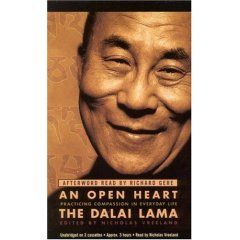
It's very common for people to project their own unwanted feelings and judgments onto others. And it typically causes great suffering. The Dalai Lama speaks to this in his book, An Open Heart:
As we contemplate the way in which we project our judgments – whether positive or negative – upon people as well as objects and situations, we can begin to appreciate that more reasoned emotions and thoughts are more grounded in reality. This is because a more rational thought process is less likely to be influenced by projections. Such a mental state more closely reflects the way things actually are – the reality of the situation. I therefore believe that cultivating a correct understanding of the way things are is critical to our quest for happiness.If we see things the way they are rather than make up stuff about them, we will avoid the kind of projections that cause suffering - both to ourselves and others.
Friday, September 15, 2006
 Found on OpenPhoto.net
Giving what we think we lack
Here's a quote that contains a lot of wisdom. It's by Neale Donald Walsch from his book Tomorrow's God:
You never need anything when you give away that which you thought you lacked...you suddenly experience that you had it to give all along.This is actually the principle behind the compassion practice of "sending and taking" or tonglen. When we have a problem, we do tonglen for others with the same problem. We take in the pain and suffering of the others and we send them the happiness and well-being they need. Through this, we actually feel better ourselves - that is to say, we discover that we had within us what we thought we lacked.
Thursday, September 14, 2006
Remaking ourselves
It's interesting that someone who came as close to "remaking" the world as anyone happened to say something like this:
It is the meditative process that enables us to engage in the "remaking" in an effective way. Otherwise, we tend to be trapped by patterns that simply repeat themselves. Meditation helps us first observe the mind as it actually is and then, from the insight this observation brings us, to make different choices than we would have made when stuck in our old patterns. It's a slow process, to be sure, but a very reliable one!As human beings, our greatness lies not so much in being able to remake the world -- that is the myth of the "atomic age" -- as in being able to remake ourselves.
Wednesday, September 13, 2006

We are more alike than different
One of the fundamental meditative principles is that we are not really separate; we are, rather, profoundly connected. It is to our great good that we dispose ourselves to remembering this great truth. Maya Angelou speaks to such an understanding in a passage from her book, Wouldn’t Take Nothing for My Journey Now:
Human beings are more alike than unalike, and what is true anywhere is true every-where, yet I encourage travel to as many destinations as possible for the sake of education as well as pleasure.Yes, we may even become friends. And how seriously that it needed today. I'm grateful for the little traveling that I've done and how that has broadened me. But even if we can't travel much, we can use our imagination. And that will go a long way toward enabling us to understand and appreciate one another.
It is necessary, especially for Americans, to see other lands and experience other cultures. The American, living in this vast country and able to traverse three thousand miles east to west using the same language, needs to hear languages as they collide in Europe, Africa, and Asia.
A tourist, browsing in a Paris shop, eating in an Italian ristorante, or idling along a Hong Kong street, will encounter three or four languages as she negotiates the buying of a blouse, the paying of a check, or the choosing of a trinket. I do not mean to suggest that simply overhearing a foreign tongue adds to one's understanding of that language. I do know, however, that being exposed to the existence of other languages increases the perception that the world is populated by people who not only speak differently from oneself but whose cultures and philosophies are other than one's own.
Perhaps travel cannot prevent bigotry, but by demonstrating that all peoples cry, laugh, eat, worry, and die, it can introduce the idea that if we try to understand each other, we may even become friends.
Tuesday, September 12, 2006
Some interesting research on pain
This morning I found another interview with Jon Kabat-Zinn - this one about pain. Here's a research finding that is very interesting indeed:
There have been studies looking at how the mind processes acute pain at the sensory level. Subjects are randomized between two groups, then given the cold pressor test, where a tourniquet is placed around your bicep, then you stick your arm into ice water. There's no more blood flow, so your arm gets very painful very fast. They measure how long you can keep your arm in the water as a function of whether you are given an attentional strategy, such as paying attention to the sensations and really moving into them and being with them as nonjudgmentally as you can—a mindfulness strategy, in other words—or a distraction strategy, where you just try to think about other things and tune out the pain. What they found was that in the early minutes of having your arm in the ice water, distraction works better than mindfulness: You're less aware of the discomfort because you're telling yourself a story, or remembering something, or having a fantasy. But after the arm is in the cold water for a while, mindfulness becomes much more powerful than distraction for tolerating the pain. While distraction alone, once it breaks down and doesn’t work, you’ve got nothing.So learning and practicing mindfulness is going to give a major pay-off when we're faced with really intractible pain. And I want to remind everybody that this is true for emotional pain as well as physical pain. Mindfulness is the tool we need for relating skillfully with our pain - no matter what kind of pain it is.
Monday, September 11, 2006

The contemplative outlook
This is from a book simply called Perspectives:
Let us accept the invitation, ever-open, from the Stillness, taste its exquisite sweetness, and heed its silent instruction.
-- Paul Brunton
Sunday, September 10, 2006
More on the benefits of meditation
As I was driving home from church today, I happened to hear an interview of Jon Kabat-Zin on NPR. Kabat-Zinn is the founder and director of the Stress Reduction Clinic at the University of Massachusetts Medical Center in Worcester, Massachusetts, as well as Associate Professor of Medicine in the University's medical school. Today he mentioned a study done with psoriasis patients. Apparently those who meditated while receiving ultra-violet treatment for their disease experienced skin healing that was four times faster than those who didn't meditate. That's really quite extraordinary.
I found the transcript of another interview of Kaba-Zinn on line and I want to share with you this story that he tells:
I found the transcript of another interview of Kaba-Zinn on line and I want to share with you this story that he tells:
There was a famous trial in Massachusetts a few years ago. The defense lawyer was a long-term Vipassana student. After the jury had been selected, the judge delivered instructions on how to listen to evidence. It was pure mindfulness teaching: moment-to-moment, dispassionate, non-judgmental awareness - listening mind. The lawyer approached the judge later and asked, "Where the hell did you get that?" The judge replied "Oh, I'm taking the stress reduction class at the U. Mass, Medical Center, and it seemed we could use a little more mindfulness in our judicial proceedings."Benefits abound!
Saturday, September 09, 2006
Ancient wisdom
 Euripides
 Three by Euripides (484 BC - 406 BC):
The best and safest thing is to keep a balance in your life, acknowledge the great powers around us and in us. If you can do that, and live that way, you are really a wise person.
~~~
I have found power in the mysteries of thought,
exaltation in the changing of the Muses;
I have been versed in the reasonings of human beings;
but Fate is stronger than anything I have known.
~~~
Slight not what's near, while aiming at what's far.
Friday, September 08, 2006

A VERY good observation
This is by Brother David Steindl-Rast from his book, A Listening Heart:
Happiness is not what makes us grateful. It is gratefulness that makes us happy.Don't wait to be grateful. Start now. Find something that you're grateful for - anything. Can you see? Be grateful for that. Is the sky blue today? Be grateful for that. I was grateful for last night's unbelievably stunning full moon. Find something. Happiness will follow. It really will.
Thursday, September 07, 2006
Giving back

It is a very great gift, really, to allow oneself to be helped. Interestingly, what usually happens is that the person who was helped is then moved to help others in return. Here's a story about that as told by Mother Teresa:
For some time now, we have had a small community of sisters in Guatemala. We came there during the earthquake of 1972 that caused so much damage.I don't happen to see a much material poverty in my work with people but I see a lot of emotional and spiritual poverty. And I know that cultivating compassion - first for oneself and then for others - is the remedy. Cultivating this compassion begins with the willingness and the humility to receive the help that is needed. Only then are we equipped to pass it on.
The sisters in Guatemala came to love and serve, as they do everywhere, They told me something beautiful about a very poor man who was picked up from the city streets and brought to one of our homes. He was very sick, disabled, hungry, and helpless. But somehow, with the help he received he got well again.
He told the sisters, "I want to go and leave this bed for somebody else who may need it as much as I needed it when I came here."
Now he has a job. I don't think he earns much, but he is working. Every time he gets a little money, he remembers the other disabled people who are in the home and comes to see them. He always brings something for them. Even with the little he has, he always brings something.
This is the great gift of our poor people: the love they have.
Wednesday, September 06, 2006

Countering obstacles to meditation
Here's something the Dalai Lama said in his book, Transforming the Mind:
To summarize, we have seen that in order to counter the four obstacles to meditation, and particularly the two principal ones, distraction and mental laxity, what is required is the skillful application of two important mental faculties: mindfulness and introspection. Through introspection we develop a vigilance that enables us to see whether, at any given moment, our mind is under the influence of excitement or distraction, and whether it is focused or lapsing into dullness, Once we have observed our state of mind, mindfulness allows us to bring our attention back to the object of meditation and to remain focused on it. So we could say that the practice of mindfulness is the essence of meditation.Actually, I've known quite a number of people who've experienced positive results from meditation surprisingly quickly. The important thing is, however, not to be attached to the idea of results. Simply meditate in order to meditate - truly for its own sake. Results happen but an attachment to results will sabotage the process.
Whatever forms of meditation you practice, the most important point is to apply mindfulness continuously, and make a sustained effort. It is unrealistic to expect results from meditation within a short period of time. What is required is continuous sustained effort.
Tuesday, September 05, 2006
Guard your peace
Three observations from a great philosopher:
Strive to do your work with feelings of peace – and give yourself freedom from all other thoughts. You deserve the freedom that a peaceful mind brings. If you seek only peace, you will see how easy it is to live a happy live – one that is like the life of the gods.
~~~
Do activities break you from your peace? If so, give yourself some quiet time to return to your path. If necessary, change directions or take up a new activity. The most important thing in life is to have a focus and purpose.
~~~
It’s not another person’s mind that destroys us, but our own. If we are watchful of our mind’s contents, we will rise above the troubles of the outside world.
Monday, September 04, 2006

Labor Day meditation
A meditation teacher named Susan Kramer has a regular column on the website BellaOnline. I've brought you her meditations before and I'm happy to do that again today as a Labor Day special. Here's what she has to say:
Labor Day is dedicated to rest, relaxation and celebrating all the effort we put into work.This is an exercise in appreciation, isn't it? While you're at it, why not contemplate with appreciation and gratitude all the working class people who make your way of life possible - from field laborers to service industry workers to clerks in stores. Then do what you can in terms of action to support economic justice for all.
This is a perfect opportunity to commemorate through a walking meditation in nature …
To begin, pick a familiar trail so you needn't worry about where your next step may lead, while reflecting inwardly on the benefits received in your life by giving "your all" to work.
Set out in an even rhythm such as taking 2 steps to breathe in and 2 steps to breathe out. Let your arms swing at your sides - right arm and left leg forward, then left arm and right leg forward. This practice develops right-left brain synchronicity.
Walking along in stride let your thoughts turn to appreciation for all gained in life by your labors, such as the essentials of life for yourself and family, and the companionship of coworkers and colleagues.
Sunday, September 03, 2006
The importance of inner work
Today I want to bring you a passage from the writings of John Dear, a Jesuit priest who is committed to the work of peace. In it we see how important it is to confront and heal the violence that lives within:
A few years before his death in 1999, the great Latin American advocate for the poor, Brazil's Archbishop Dom Helder Camara, was speaking at a crowded church in Berkeley, California. He was asked, "After facing death squads, would-be assassins, corporations oppressing the poor, violent government opposition, and even hostile forces within your own church, who is your most difficult opponent?"We cannot truly show mercy to others until we show mercy to ourselves. We cannot genuinely forgive others until we forgive ourselves. We cannot authentically befriend or accept or love others until we befriend and accept and love ourselves. There's no other way, my friends. Please believe me; there's no other way.
Without saying a word, Dom Helder pointed his hand into the air, then slowly arched it around, until it turned on himself, his index finger pointing to his heart. "I am my own worst enemy," he said, "my most difficult adversary. Here I have the greatest struggle for peace."
Likewise, Mahatma Gandhi was once asked about his greatest enemy. He spoke of the British and his struggle against imperialism. Then he reflected on his own people, and his struggles against untouchability, bigotry, and violence in India. Finally, he spoke of himself, and his own inner violence, selfishness, and imperfection. The last, he confessed, was his greatest opponent. "There I have very little say."
If we want to make peace with others, we first need to be at peace with ourselves. But this can sometimes be as difficult as making peace in the bloodiest of the world's war zones.
Those who knew Dom Helder Camara and Mahatma Gandhi testify that they radiated a profound personal peace. But such peace came at a great price: a lifelong inner struggle. They knew that to practice peace and nonviolence, you have to look within.
Peace begins within each of us. It is a process of repeatedly showing mercy to ourselves, forgiving ourselves, befriending ourselves, accepting ourselves, and loving ourselves.
Saturday, September 02, 2006
Generosity
The happy heart gives away the best. To know how to receive is also a most important gift, which cultivates generosity in others and keeps strong the cycle of life.
Friday, September 01, 2006

Happiness is an inside job
 Dr. Johnson
The fountain of content must spring up in the mind, and he who hath so little knowledge of human nature as to seek happiness by changing anything but his own disposition, will waste his life in fruitless efforts and multiply the grief he proposes to remove.
Thursday, August 31, 2006
Discernment

Meditation is not to escape from society, but to come back to ourselves and see what is going on. Once there is seeing, there must be acting. With mindfulness, we know what to do and what not to do to help.
A Grateful Death
Linda Cole sent me this marvelous passage from the writings of Henri Nouwen:
When we think about death, we often think about what will happen to us after we have died. But it is more important to think about what will happen to those we leave behind. The way we die has a deep and lasting effect on those who stay alive. It will be easier for our family and friends to remember us with joy and peace if we have said a grateful good-bye than if we die with bitter and disillusioned hearts.What a beautiful reflection on the place of gratitude at the end of life. The way we will be able to practice gratitude then is to practice it now. Let us all commit to giving this wonderful gift to those we leave behind.
The greatest gift we can offer our families and friends is the gift of gratitude. Gratitude sets them free to continue their lives without bitterness or self-recrimination.
Wednesday, August 30, 2006

Still more on gratitude
I found an article this morning entitled "Try a gratitude meditation to reduce anxiety and depression". Here's part of what it says:
There's always something to give thanks for. Look for those things. And really cultivate an appreciation for them.
It is easy to get caught up in the comparison game. Competition is a big part of Western culture. We want to have the most and the biggest of everything. Unfortunately, there is always someone else who makes more money, has a bigger house and a better job.I like the recommendation that we visualize each gift. I also think the commitment to five minutes a day is a good one. I would also remind everybody to exercise gratitude for things like being able to walk, being able to see, having the intelligence to understand this exercise and the like. Otherwise, it's easy to get into self-pity if we don't have a spouse or children or a job we enjoy.
Irrationally, we compare ourselves to those we think have more than we do and we lose every time. We frequently focus on one aspect of their success and we exaggerate it while diminishing the importance of our own achievements. I talk to very successful fathers and mothers who are depressed because they don't have the things their neighbors do.
Comparison thinking results in a depressed mood and anxiety, as well as feelings of guilt and disappointment. It stems from organizing our thoughts in a results-based manner. Our fantasy is that an increase in production will lead to an increase in happiness. In reality, as our production increases, we raise our expectations of what we feel will make us happy.
An effective alternative is to develop an attitude of gratitude. This type of thinking focuses us on what we already have and deepens our love and appreciation for our loved ones and our purpose in life. It results in contentment and a deep inner peace.
To develop the mental muscles required to obtain a higher state of inner peace, commit to five minutes of gratitude meditation every morning. Find a quiet place and concentrate on a mental list of four or five people or things that you are grateful for. It might sound like this. "I am grateful for my loving husband, my beautiful children, my health, my home and a job I enjoy."
As you name each gift, visualize it as vividly as you can for as long as possible. Be aware of how you feel and give thanks. If you do this daily, you will find that your love for others will deepen and inner peace will develop.
Your confidence in yourself will grow stronger and others' success will not take anything away from your own contentment. You will feel happy when others succeed instead of resentful. Research has suggested that people who do this have less depression and anxiety.
There's always something to give thanks for. Look for those things. And really cultivate an appreciation for them.
Tuesday, August 29, 2006
Let's not say we've arrived!
All [meditation methods] take work. There is no easy or royal road to the goal we seek. Further, there is no end to the search; there is no position from which we can say, "Now I have arrived, I can stop working."
Managing stress
This morning I found an article entitled "Simple stress busters: 10 ways to take control and feel better fast." It will not surprise you to know that one of the ten ways listed is meditation. Here's what the article has to say about it:
Meditation is the process of learning how to focus one's awareness. Studies have linked meditation to lowered blood pressure, decreased heart and respiratory rate and increased blood flow -- all signs of relaxation. Mindful meditation, which involves focusing fully on what is happening in the present, "allows you to choose what you pay attention to, which is very powerful," says Dr. Howard Schubiner, director of the Mind-Body Medicine Center at St. John Providence Hospital in Southfield. "It helps you not be a prisoner to your thoughts. You feel it, you observe it, and then you choose how to respond." Theresa Randolph of Mount Clemens practices the techniques she learned during a recent meditation class.You might want to click through and check out the other stress busters. They're all good!
"You feel balanced, you feel in control, you feel in charge," she says. "If you can accomplish that, sit down and only think about one thing, you don't feel like the whole world is controlling you. Sometimes you get running so much you lose track of yourself. Meditation gives you a chance to regroup."
Try to practice meditation daily, even if it's just for a few minutes. Focus on your breath, on a phrase or word repeated silently, or on a visualized image; when your mind wanders, gently bring it back to whatever you were focusing on and continue.
Monday, August 28, 2006

Becoming human
The greatest human quest is to know what one must do in order to become a human being.
Letting go
 Photo by Cynthia Burgess
This morning I found a marvelous poem by Rilke. The image is powerfully evocative and compelling, I think:
This clumsy living that moves lumbering
as if in ropes through what is not done,
reminds us of the awkward way the swan walks.
And to die, which is the letting go
of the ground we stand on and cling to every day,
is like the swan, when he nervously lets himself
down
into the water, which receives him gaily
and which flows joyfully under
and after him, wave after wave,
while the swan, unmoving and marvelously calm,
is pleased to be carried, each moment more fully
grown,
more like a king, further and further on.
-Translated by Robert Bly
Sunday, August 27, 2006
Remembering Russ Bennett
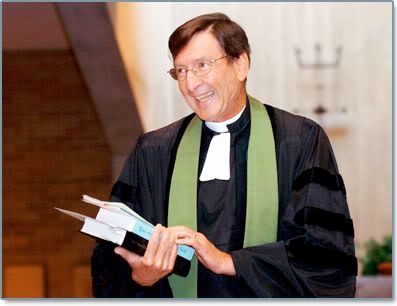
The Rev. Russell Bennett (1937-2006)
It is with great sadness that I share with you the news that my friend and colleague, The Rev. Russell Bennett, died today at 4:00 a.m. after a long illness. Russ was very supportive of me throughout the years; he invited me to preach several times at Fellowship Church and to lead their parish retreat twice. He was truly a delight to work with and I will miss him very much. Here's what Hope Unitarian Church said of Russ when awarding him their Religious Liberty Award on April 30, 2005:
Russ Bennett is a Tulsa Treasure. As the Minister Emeritus of Tulsa’s Fellowship Congregational Church (which he served for 36 years), he exemplifies the qualities of leadership: Honesty, Vision, Forward Looking and Competent. He has used those qualities to work for the least among us. By doing so he has become one of the greatest among us. He is a man – as one writer observed – who “stood with the African Americans when the KKK demonstrated, he stood with the Jews when their cemetery was vandalized, he stood with the Muslims at our Senator’s office after September 11, he stood with African American police officers in the law suit against the city of Tulsa . . . he stood with Native Americans trying to abolish a demeaning mascot.” His life stands as a reminder of what Captain Bill Mcdonald, one of the legendary Texas Rangers, once said: “No man in the wrong can stand up against a fellow that’s in the right and keeps on a-coming.” Russ Bennett is such a man. He is also one of the gentlest of souls. His soft spokeness is a constant reminder that those with whom we disagree are our brothers and sisters. Always standing up for what he believes, he supports that most basic of freedoms, freedom of religion. Through word and deed he has promoted and defended Religious Freedom for all.
As it happens, I marched beside Russ in that demonstration with the Tulsa Muslims mentioned above. We were the only two Christian ministers present which I thought was shameful. Russ was very active in Tulsa Interfaith Alliance and truly believed in interfaith dialogue and cooperation. He was an inspirational example of humily and compassion and will be greatly missed. I'm honored to have known him.
May he rest in peace and may light perpetual shine upon him.
More on gratefulness
From the book, Gratefulness, the Heart of Prayer:
What brings fulfillment is gratefulness, the simple response of our heart to this life in all its fullness.
Saturday, August 26, 2006
More from Peace Pilgrim
As you know, Peace Pilgrim is somone who walked for peace - without possessions, without money. She depended on the kindness of people who would give her food and shelter for the duration of her twenty-eight year pilgrimage. In her remarks about attaining inner peace she talks about the importance of relinquishments. Here's part of what she said:
Now the last: the relinquishment of all negative feelings. I want to mention just one negative feeling which the nicest people still experience, and that negative feeling is worry. Worry is not concern which would motivate you to do everything possible in a situation. Worry is a useless mulling over of things we cannot change. Let me mention just one technique. Seldom do you worry about the present moment; it's usually all right. If you worry, you agonize over the past which you should have forgotten long ago, or you're apprehensive over the future which hasn't even come yet. We tend to skim right over the present time. Since this is the only moment that one can live, if you don't live it you never really get around to living at all. If you do live this present moment, you tend not to worry. For me, every moment is a new opportunity to be of service.I don't know why negative feelings are so addictive but I do know that this addiction is one worth breaking. We do this not by judging our feelings but by accepting them, choosing not to give them energy and then by letting them go. I love how Peace Pilgrim talks about her decision to stop hurting herself. We can do that too.
One last comment about negative feelings which helped me very much at one time and has helped others. No outward thing - nothing, nobody from without - can hurt me inside, psychologically. I recognized that I could only be hurt psychologically by my own wrong actions, which I have control over; by my own wrong reactions - they are tricky but I have control over them, too; or by my own inaction in some situations, like the present world situation, that needs actions from me. When I recognized all this, how free I felt! And I just stopped hurting myself. Now someone could do the meanest thing to me and I would feel deep compassion for this out-of-harmony person, this psychologically sick person who is capable of doing mean things. I certainly would not hurt myself by a wrong reaction of bitterness or anger. You have complete control over whether or not you will be hurt psychologically, and any time you want to, you can stop hurting yourself.
Friday, August 25, 2006

The power of thought
It's been a while since I've posted anything by Peace Pilgrim and so I'm delighted today to bring you something she said about the power of thought:
Are you a slave to your self-centered nature, or does your divine nature guide your life? Do you know that every moment of your life you're creating through thought? You create your own inner condition; you're helping create the conditions around you.While I'm at it, I'd like to share something she said about Christianity:
...
If you realized how powerful your thoughts are, you would never think a defeatist or negative thought. Since we create through thought, we need to concentrate very strongly on positive thoughts. If you think you can't do something, you can't. But if you think you can, you may be surprised to discover that you can. It is important that our thoughts be constantly for the best that could happen in a situation -- for the good things we would like to see happen.
Many people profess Christianity. Very few live it -- almost none. And when you live it people may think you're crazy. It has been truthfully said that the world is equally shocked by one who repudiates Christianity and by one who practices it.Yes, indeed. It would be a most wonderful world.
I believe Jesus would accept me because I do what he told people to do. This doesn't mean, though, that all who call themselves Christian would accept me. Of course I love and appreciate Jesus and I wish Christians would learn to obey his commandments. It would be a most wonderful world.
Thursday, August 24, 2006
What it means to be a seeker
I have a lot of respect for the teacher and writer Lama Surya Das. Here's a passage from his book, Awakening to the Sacred:
Seekers want to understand and explore themselves as well as the universe with all its mysteries, both known and unknowable. In their hearts, seekers believe that the universe makes sense and their lives have meaning. They believe not only that truth exists, but that it can indeed be found, and experienced.So, no, you don't have to make a pilgrimage to India or Tibet or Canterbury to find the sacred. You can make a pilgrimage within. The important thing is to begin and not to give up.
When I was young, and even more foolish than I am today, I believed that one had to travel far and wide in order to seek truth, divine reality, or whatever you call it. I believed that truth would most likely be found in the world's so-called sacred places. Yet the fact is that truth is everywhere; it knows no religious, cultural, temporal, or ethnic bounds. Truth is the perfect circle. Its center is everywhere; its circumference stretches into infinite space. The land on which we stand is sacred, no matter where we stand.
Wednesday, August 23, 2006
Important observation

Gregory the Great
This is from a letter to Augustine of Canterbury:
Those who would climb to a lofty height must go by steps, not leaps.
So let us be patient with ourselves but never give up!

Perseverance
Charlotte Joko Beck is, in my opinion, one of the most outstanding meditation teachers writing today. Here is something she said about enlightenment:
Enlightenment is not something you achieve. It is the absence of something. All your life you have been going forward after something, pursuing some goal. Enlightenment is dropping all that. But to talk about it is of little use.Yes, enlightenment is the absence of something. It's the absence of striving, of competition, of the demand to gratify the ego. It's a profound "okayness" with oneself, a joyful letting go, an unconditional acceptance of what is. So let's keep practicing with all of our might. It's worth it!
The practice has to be done by each individual. There is no substitute. We can read about it until we are a thousand years old and it won't do a thing for us. We all have to practice, and we have to practice with all of our might for the rest of our lives.
Tuesday, August 22, 2006
Taking refuge in the community
We need support from one another. Ram Dass speaks to that in the following paragraph from The Only Dance There Is:
Thus, when you define yourself as a seeker after sensual gratification then you surround yourself with other people who are seekers after sensual gratification. When you define yourself as an intellectual you often surround yourself with intellectuals. When you define yourself as a seeker after consciousness, you start to surround yourself with other seekers after consciousness, because in that phase being around such people really gives you a kind of environmental support.When it comes to your inner work and your spiritual development, who you hang out with matters. This is why coming to meditation class is so helpful. We break out of our isolation that way and connect with other people who care about developing mindfulness and becoming aware. But even if you're in an area where coming to class is not an option, you can connect with the community of practitioners by knowing deeply that others on the path to awakening are supporting you on a spiritual plane. And you can know that you are supporting them as well.
Monday, August 21, 2006

Moments in flow
A very wonderful book on meditation, one that has become a classic, is Journey of Awakening: A Meditator's Guidebook by Ram Dass. Here's his very lovely description of what pure awareness is like:
There have been moments in your life when you were pure awareness. No concepts, no thoughts like "I am aware" or "That is a tree" or "Now I am meditating." Just pure awareness. Openness. A spacious quality in your existence. Perhaps it happened as you sat on a river bank and the sound of the river flowed through you. Or as you walked on the beach when, the sound of the ocean washed away your thinking mind until all that remained was the walking, the feeling of your feet on the sand, the sound of the surf, the warmth of the sun on your head and shoulders, the breeze on your check, the sound of the seagull in the distance.Meditation helps us dispose ourselves to moments like this - so that they aren't relegated to just happening by chance. We can't force this experience but we can train ourselves to let go of the usual obstacles to it. Let yourself remember when this has happened to you. Then commit yourself to being open to it now and to train your mind to dispose yourself toward this awareness as a regular practice.
For that moment your image of yourself was lost in the gestalt, in the totality of the moment. You were not clinging to anything. You were not holding on to the experience. It was flowing--through you, around you, by you, in you. At that moment you were the experience. You were the flow. There was no demarcation between you-sun-ocean-sand. You had transcended the separation that thought creates. You were the moment in all its fullness.
Everyone has had such experiences. These moments are ones in which we have "lost ourselves," or been "taken out of ourselves," or "forgotten ourselves." They are moments in flow.
It is in these moments of your life that there is no longer separation. There is peace, harmony, tranquility, the joy of being part of the process. In these moments the universe appears fresh; it is seen through innocent eyes. It all begins anew.
Sunday, August 20, 2006
Healing old wounds
Today I picked up 1,001 Meditations by Mike George again and I found two visualizations that really go together and that can be very valuable for inner work. Here's the first one:
Many of the emotional wounds that we carry around were inflicted when we were children. One way to heal such wounds is to comfort the child within. Imagine a child standing before you. Gazing down at the child, you realize that it's you when you were small. Kneel down beside the child and introduce yourself. Encourage them to come toward you. If they are willing, hold them close to your heart in a warm embrace. Reassure the child that they are safe in your arms and that you will always be there to protect them from harm.And the other visualization is an exercise in re-parenting:
Visualize the perfect parents. What qualities would they display? Take time to refine and build your vision each day for a week. When your vision is complete, introduce yourself to your imaginary parents and begin to cultivate a loving relationship.Inner re-parenting is much more effective and reliable than the common approach of looking for a surrogate parent. It's really an exercise in self-coaching. We train ourselves to tell ourselves what a good parent would say - and that displaces the often critical, condemning voice with which we may have habitually spoken to ourselves. And, of course, this process will help us in our relationships with other people - especially children and young people - because we will truly choose what we want to say to them instead of reflexively saying the things that were once said to us.
Saturday, August 19, 2006
Appreciation of ordinary things
Can you see the holiness in those things you take for granted – a paved road or a washing machine? If you concentrate on finding what is good in every situation, you will discover that your life will suddenly be filled with gratitude, a feeling that nurtures the soul.
Friday, August 18, 2006

Letting go
This is from the book, Glimpse After Glimpse:
Although we have been made to believe that if we let go we will end up with nothing, life reveals just the opposite: that letting go is the real path to freedom.
Thursday, August 17, 2006
Setbacks
This moring I found the transcript of a conversation between Pema Chödrön and Alice Walker. I really recommend that you click through and read the whole thing. It's very illuminating and inspiring. But the passage I want to quote here has to do with Pema Chödrön's response to a question about why we end up working on the same issues over and over again even when we think we've made a lot of progress on staying open and letting go. I really like her reply:
That's how life keeps us honest. The inspiration that comes from feeling the openness seems so important, but on the other hand, I'm sure it would eventually turn into some kind of spiritual pride or arrogance. So life has this miraculous ability to smack you in the face with a real humdinger just when you're going over the edge in terms of thinking you've accomplished something. That humbles you; it's some kind of natural balancing that keeps you human. At the same time the sense of joy does get stronger and stronger.I often find myself reminding people to let go of their attachment to an idealized self. Setbacks actually help us do that if we don't use them as occasions to beat ourselves up. Setbacks can also help us cultivate genuine empathy with others but most of all they will help us avoid spiritual pride if we accept them without judgment.
Wednesday, August 16, 2006

Idiot compassion
I want to share with you some more from Pema Chödrön's teachings - this time on something called "idiot compassion". This is the sort of behavior that you tell yourself is compassionate but actually it hurts either you or the person you believe you are helping. Here's what she has to say about it:
Idiot compassion is a great expression, which was actually coined by Trungpa Rinpoche. It refers to something we all do a lot of and call it compassion. In some ways, it's whats called enabling. It's the general tendency to give people what they want because you can't bear to see them suffering. Basically, you're not giving them what they need. You're trying to get away from your feeling of I can't bear to see them suffering. In other words, you're doing it for yourself. You're not really doing it for them.I think idiot compassion stems from a kind of spiritual laziness. We do the easy thing rather than the hard thing and then we delude ourselves by believing we are helping. I think it is safe to say that idiot compassion always involves some kind of boundary eroision.
When you get clear on this kind of thing, setting good boundaries and so forth, you know that if someone is violent, for instance, and is being violent towards you —to use that as the example— it's not the compassionate thing to keep allowing that to happen, allowing someone to keep being able to feed their violence and their aggression. So of course, they're going to freak out and be extremely upset. And it will be quite difficult for you to go through the process of actually leaving the situation. But that's the compassionate thing to do.
It's the compassionate thing to do for yourself, because you're part of that dynamic, and before you always stayed. So now you're going to do something frightening, groundless, and quite different. But it's the compassionate thing to do for yourself, rather than stay in a demeaning, destructive, abusive relationship.
And it's the most compassionate thing you can do for them too. They will certainly not thank you for it, and they will certainly not be glad. They'll go through a lot. But if there's any chance for them to wake up or start to work on their side of the problem, their abusive behavior or whatever it might be, that's the only chance, is for you to actually draw the line and get out of there.
Tuesday, August 15, 2006
Gratefulness
This is from Gratefulness, the Heart of Prayer:
From experience we know that whenever we are truly awake and alive, we are also truly grateful.
Still more on happiness
A very wonderful book that we use at the Center in the Saturday morning Karma Kagyu class is The Essence of Buddhism by Traleg Kyabgon. Here's a powerful passage on happiness and spiritual practice:
Spiritual practice is about being, or becoming, a different person; having a different experience of our own being. It has scarcely anything to do with what we have in terms of job, family, and so forth. This does not mean that we should reject our family in order to be spiritual, or that we should stop working and live in the jungle in order to be spiritual. Even the happiness that we may feel in the jungle will turn into unhappiness when the mosquitoes and the snakes start biting! Real happiness has to come from within, from having a greater understanding of ourselves. As our inner struggles and conflicts gradually lessen and we become more integrated, we gain a sense of peace. We will not stop having problems in life, because many problems come from the external world. However, the inner sense of integration enables us to deal with whatever arises in our life. This is the kind of thing we have to work with on the path of preparation.What kind of conviction is he talking about here? Well, that we actually can become a different person, that the meditative principles really do work - no matter what. And I think the point that he makes - that we will not stop having problems in life - is an important one. Our problems don't magically disappear but, through our spiritual practice, we develop the skills to work with them effectively.
We begin to realize where the real source of happiness lies, and this makes us keen to pursue the path. If we are not convinced, if we are not looking forward to our destination, the journey cannot take place.
Monday, August 14, 2006

The journey
When you are on a journey, it is certainly helpful to know where you are going…but don't forget: the only thing that is ultimately real about your journey is the step that you are taking at this moment.
Happiness
I want to bring you another passage from the commencement address by Sylvia Boorstein that I posted yesterday. This paragraph is from the very beginning of her speech and it's about the importance of happiness:
One of my meditation teachers used to end each of our interviews actually, I'd have my hand on the door ready to leave, and she'd say to me, "Remember, Sylvia, be happy," and I'd go out and I actually for a long time thought it was a salutation, like "have a good day" or something that you say just in a routine kind of a way, and it took me a long time to realize that it was an instruction, "Be happy," and not only that it was an instruction but that it was a wisdom transmission, that happiness was a possibility. I understand that happiness to mean the happiness of a mind that's alert, that's awake to the amazing potential of being a person in a life, with a mind that's opened, that sees everything that's going on, that sees my own life drama and the drama of life, and realizes what an amazing possibility this is, and with a heart that's open, the heart that responds naturally as hearts do, in compassion, in connection with friendliness, with love, with consolation when it needs to, that that's the happiness of life, a mind that's awake, a heart that's engaged...So, you see, happiness is not about getting what we want. It's about keeping our heart open. And that is something we can all choose to do - no matter what our outward circumstances happen to be.
Sunday, August 13, 2006
Insight
The insights of insight meditation are intuitive, not conceptual. Intuitive in this sense does not mean some kind of vague feeling about something; rather, it means clearly, directly seeing and experiencing how things really are.

Sylvia Boorstein is a meditation teacher whom I admire very much. Today I just happened to stumble upon the transcript of a commencement address she gave at Stanford University last year. In it she speaks of three wisdoms. It's the third I want to share with you here:
And the third thing, again, is the recognition that no one does anything alone, that is, all causes and conditions. It relieves me personally of worrying too much about praise or blame. If I do something good, I think to myself, well, great, this is my teacher's and my parents' and my whole life speaking through me at this moment and acting through me, and I am very, very grateful for all of my teachers and all the people that make me who I am today, and I figure I share the merit with them. They're part of it. And when I don't do so well, when I don't do as well as I wish, I can also distribute the dismay and say this is not my fault. All of my committee did not show up in exactly the right proportions today, but they will another time, so thank you, committee, and we carry on. I don't have to carry the whole burden myself. I'm part of the committee but I'm not the whole committee. That's a great piece of awareness. That's what's supposed to happen from paying attention.What she's talking about is connectedness, isn't she? You know, I observe such terrible suffering when people get caught up in blaming themselves. There is equal suffering, interestingly enough, in the attachment to self-praise because we can't triumph all the time, can we? Wouldn't it be more skillful to realize that it's not all about the individual? My successes aren't all about me and neither are my failures. John Donne said it best: "No man is an island, entire of itself..." We are all profoundly connected.
Saturday, August 12, 2006
Stress and the ego
Well, they cause suffering, don't they? Here's a description of how that works from an article by Pema Chödrön:
It's as if you had vast, unlimited space —complete openness, total freedom, complete liberation —and the habit of the human race is to always, out of fear, grasp onto little parts of it. And that is called ego and ego is grasping on to the content of our thoughts. That is also the root of suffering, because there is something in narrowing it down which inherently causes us a lot of pain because it is then that we are always in a relationship of wanting or not wanting. We are always in a struggle with other people, with situations, even with our own being. That's what we call stress. That's what we experience as continual, on-going stress. Even in the most healthy, unneurotic of us, there's some kind of slight or very profound anxiety of some kind, some kind of uneasiness or dissatisfaction.Then she explains the choice between alleviating our suffering or choosing to prolong it:
But what is always accessible to us in any moment as our birthright is actually the completely open and vast nature of our mind. And what we call ego is narrowing it down and grasping on to small parts, which is our personal experience is saying, "I want this and I don't want that," "I like this and I don't like that." We are grasping onto our limited thinking instead of staying with what's really possible for us.Finally she sums up mindfulness:
It also isn't getting rid of thoughts so much as letting thoughts play in the vast space of which we are a part, if we could only realize it."If we could only realize it." We can train ourselves to begin to realize it by meditating and by letting go of ego-grasping. Even if at first we can only do this in small ways, those small ways will help us develop the skills we need for letting go of stronger, more deeply entrenched attachments. The important thing to remember is commitment and perseverence. Never give up and liberation is yours!
Friday, August 11, 2006

The problem with perfectionism
In the January 2004 issue of O Magazine, Sharon Salzberg takes a look at skillful ways of dealing with our own failures and imperfections. Here are several quotes from that article:
Remember, perfectionism is really a form of pride. Let's all have the humility to let go of the need to be perfect because if we're able to forgive ourselves we can more easily forgive others.
By prizing heartfulness above faultlessness, we may reap more from our effort because we're more likely to be changed by it.
...
If we fall, we don't need self-recrimination or blame or anger - we need a reawakening of our intention and a willingness to recommit, to be whole-hearted once again.
...
Often we can achieve an even better result when we stumble yet are willing to start over, when we don't give up after a mistake, when something doesn't come easily but we throw ourselves into trying, when we're not afraid to appear less than perfectly polished.
...
We learn and grow and are transformed not so much by what we do but by why and how we do it.
Remember, perfectionism is really a form of pride. Let's all have the humility to let go of the need to be perfect because if we're able to forgive ourselves we can more easily forgive others.
Thursday, August 10, 2006
True happiness
The happiness of one's own heart alone cannot satisfy the soul; one must try to include, as necessary to one's own happiness, the happiness of others.
Metta Sutra
The Teaching on Lovingkindness:
This is what should be done
By those who are skilled in goodness,
And who know the path of peace:
Let them be able and upright,
Straightforward and gentle in speech,
Humble and not conceited,
Contented and easily satisfied,
Unburdened with duties and frugal in their ways,
Peaceful and calm, and wise and skillful,
Not proud and demanding in nature.
Let them not do the slightest thing
That the wise would later reprove.
Wishing: in gladness and in safety,
May all beings be at ease.
Whatever living beings there may be;
Whether they are weak or strong, omitting none,
The great or the mighty, medium, short or small,
The seen and the unseen,
Those living near and far away,
Those born and to-be-born—
May all beings be at ease!
Let none deceive another,
Or despise any being in any state.
Let none through anger or ill-will
Wish harm upon another.
Even as a mother protects with her life
Her child, her only child,
So with a boundless heart
Should one cherish all living beings;
Radiating kindness over the entire world,
Spreading upward to the skies,
And downward to the depths;
Outward and unbounded,
Freed from hatred and ill-will.
Whether standing or walking, seated or lying down,
Free from drowsiness,
One should sustain this recollection.
This is said to be the sublime abiding.
By not holding to fixed views,
The pure-hearted one, having clarity of vision,
Being freed from all sense desires,
Is not born again into this world.-- The Buddha
Wednesday, August 09, 2006
Questions answered
Cynthia Burgess sent me a web page yesterday from the Oprah web site on which noted meditation teacher Sharon Salzberg answered some typical questions about meditation. I thought I'd reproduce three of the questions and answers here:
What do I do when my thoughts just won't stop?I like her point that meditation is a method of self-care. If we view it that way instead of something we "should" do then we are more likely to experience meditation as something really attractive that, in fact, we want to do.
Some people have a mistaken idea that through meditation all thoughts disappear and we enter a state of blankness. There certainly are times of great tranquility when concentration is strong and we have few, if any, thoughts. But other times, we can be flooded with memories, plans, or random thinking. It's important not to blame yourself. Notice that you don't invite your thoughts. You haven't said, "At 6:15 I'd like to be ruminating about the past." Thoughts come and go without our volition, but we don't have to be ruled by them.
Can meditation help me deal with physical pain?
What you learn about pain in formal meditation can help you relate to it in your daily life. In meditation, one of the first things you may notice about pain is that when you start to feel it in one part of your body, the rest of your body tenses up. This can increase the pain. Consciously take a deep breath and relax your muscles. As you relax physically, you will discover greater ease of mind.
Can meditation help depression?
Depression has many causes. While it is important to investigate its possible biochemical basis and seek out psychotherapeutic help if necessary, meditation may also be useful. Dedicating some time to meditation is a meaningful expression of caring for yourself that can help you move through the mire of feeling unworthy of recovery. As your mind grows quieter and more spacious, you can begin to see self-defeating thought patterns for what they are, and open up to other, more positive options.
Tuesday, August 08, 2006
More on gratitude
Now isn't this the truth?
Take full account of the excellencies which you possess, and in gratitude remember how you would hanker after them, if you had them not.
Monday, August 07, 2006

Staying deeply open
This is from A Path with Heart by Jack Kornfield:
To open deeply, as genuine spiritual life requires, we need tremendous courage and strength, a kind of warrior spirit. But the place for this warrior strength is in the heart.To my mind, the best way to cultivate the warrior strength of the heart is to practice tonglen - a compassion practice in which we share another's suffering on a spiritual plane. Practicing tonglen keeps us from closing down our heart and it brings us to a deep empathy. Interestingly, it also helps us with our own suffering. Most people report that doing tonglen reliably helps them feel better - no matter what kind of pain they're experiencing. Of course, it's not necessary to be in pain to practice tonglen. We can do it any time and any place. As Pema Chödrön says:
The tonglen practice is a method for connecting with suffering —ours and that which is all around us— everywhere we go. It is a method for overcoming fear of suffering and for dissolving the tightness of our heart. Primarily it is a method for awakening the compassion that is inherent in all of us, no matter how cruel or cold we might seem to be.
Sunday, August 06, 2006
Greatness
The foundation of greatness is honoring the small things of the present moment, instead of pursuing the idea of greatness.
Saturday, August 05, 2006
Transform your day
I remember being very affected when I learned that the Dalai Lama had said, "My religion is kindness." What would happen if we could all say that? How different the world would be! We can all begin right now to practice such a principle - no matter what. Just start your day and say to yourself, "I will be kind today." Then do it. Here's an excerpt from an article entitled "An Unconditional Gift" that speaks to this:
The components of kindness are compassion, respect, and generosity. Put simply, kindness is the conscious act of engaging others in a positive way without asking whether those individuals deserve to be treated kindly. All living beings thrive on kindness. A single, sincere compliment can turn a person's entire world around. Holding a door or thanking someone who has held a door for you can inspire others to practice politeness and make already kind individuals feel good about their efforts. Smiling at people you meet-even those who make you feel like frowning-can turn a dreary encounter into a delightful one, for both of you. Every kind act has a positive influence on the individual who has performed said act as well as on the recipient, regardless of whether the act is acknowledged. Kindness brings about more kindness and slowly but surely takes a positive toll on humanity.I like the point that we don't need to have our acts of kindness acknowledged for them to make a difference in someone's life. I take great consolation in knowing that every act of kindness on my part contributes to the sum of kindness in the world and that, ultimately, all humanity benefits.
Friday, August 04, 2006

An appropriate balance
It's important, in the meditative tradition, that we avoid indulging in black and white thinking. That kind of either/or mentality trips us up and leads to an unhealthy dualism. The reason I bring this up is because some people think that the encouragement to live "in the moment" means we should never remember the past or plan for the future. Not at all. Here's a little essay on being in the moment that expresses an appropriate balance:
Each moment of our lives is imbued with richness and magic. The passage from one second to the next is a miracle in its own right and worthy of being savored. Yet our minds tend to wander away from the present, preferring the unchangeable nature of the past or the nebulous character of the future. There is nothing inherently wrong with revisiting our personal histories or dreaming about what we hope will occur with the passage of time. To live a truly balanced life is to simultaneously embody a past, present, and future self. It is only when our ability to exist purely in the moment is lost and the joys immediately in front of us are overshadowed by the joys of the past and future that we must reestablish our connection to the present. Living in the moment empowers you to discover and appreciate what is beautiful about this unique moment in time.Sometimes it's very important to remember the past in order to understand the present and to reflect skillfully on what is happening right now. It's important, however, not to get caught up in the past in a judging way - that is, either idealizing the past or living in regret or resentment.
...
Grounding yourself in the present is simply a matter of practice. Breathing and moving consciously increases your awareness of how you occupy space from moment to moment. Focusing on life's little joys and relishing everything you do will help you learn to focus wholeheartedly on the task at hand. Living in the moment means immersing yourself fully in every experience, whether positive or negative. As you learn to embrace the present in an all-encompassing way, you will come to realize that life's magnificence is a product of its moments.
Thursday, August 03, 2006
Meditate for peace
I just found a wonderful article entitled Community Meditation promotes peace that's about a community in Washington State. Here's part of what it says:
I think it's a simply wonderful idea. I think I will send the article to the head of Tulsa Peace Fellowship. Who knows? Maybe it will catch on here in Oklahoma!
South Sound's third annual Community Meditation for Global Peace begins at noon Sunday.
The 24-hour event, which will be at the Tivoli Fountain on Capitol Campus, is free, and the public is welcome to join.
"The Community Meditation is the fulfillment of a personal vision of people gathering in silence - working for peace for ourselves, our neighbors, our community and our world," said organizer Dickie Baker of Olympia.
She credits "divine inspiration" for the idea, which came to her in April 2004.
"I was walking in Point Defiance Park with a friend, and all of a sudden everything went still, everything went quiet, and I heard, 'Why not meditate for peace?' " said Baker, 52, a waitress.
...
Last year's event drew more than 100 people, including about 20 faith leaders, many of whom participated in the hourly reading of quotes from famous peace makers.
This year's event will be completely silent, marked only by an hourly ringing of a Tibetan singing bowl, Baker said.
Interfaith Works is sponsoring this year's event because it fits well with the organization's mission of promoting events that are inclusive of all faiths, said Kathy Erlandson, its executive director.
...
"The beauty of it is that you can come for five minutes or for 24 hours," Erlandson added.
I think it's a simply wonderful idea. I think I will send the article to the head of Tulsa Peace Fellowship. Who knows? Maybe it will catch on here in Oklahoma!
Stillness
This is from Stillness Speaks:
To meet everything and everyone through stillness instead of mental noise is the greatest gift you can offer to the universe.
Wednesday, August 02, 2006

Prepare a noble death song
 Chief Tecumseh
Yesterday I received a flyer for a multi-faith program sponsored by Saint Francis Hospice and The Department of Religion of the Saint Francis Health System entitled "Easing the Pain of the Soul". The program will have a panel of speakers from all the major religions and will describe the ways "various traditions offer comfort and hope in times of terminal illness." I was very struck by the following quote included in the flyer:
Seek to make your life long and its purpose in the service of your people. Prepare a noble death song for the day when you go over the great divide. Always give a word or a sign of salute when meeting or passing a friend, even a stranger, when in a lonely place. Show respect to all people and grovel to none.
When you arise in the morning, give thanks for the food and for the joy of living. If you see no reason for giving thanks, the fault lies only in yourself. Abuse no one and no things, for abuse turns the wise ones to fools and robs the spirit of its vision.
When it comes your time to die, be not like those whose hearts are filled with the fear of death, so that when their time comes they weep and pray for a little more time to live their lives over again in a different way. Sing your death song and die like a hero going home.
Tuesday, August 01, 2006
Sympathetic joy
Yesterday, Cynthia Burgess sent me an email called Daily Om. This particular message was about the "divine abode" known as sympathetic joy -- the capacity to rejoice and experience happiness at another's success or good fortune. Here is a excerpt from that email:
Sympathetic joy is a great antidote for resentment or envy. And we can practice it for people we just hear about - we don't necessarily have to know them personally. I recommend being intentional about this practice. Actually try to think of people for whom you can have sympathetic joy. Don't just wait for it to occur to you!
We all want to be the kind of people who are happy for others when they experience success or a cause for celebration in their lives, but it isn't always easy. Sometimes powerful, dark feelings come up at times when decorum dictates that we should be feeling the opposite. Instead of reaching out and celebrating for our loved one, we may feel the rising up of our own pain. This pain may arise because we feel jealous of our friend for having something we don't have. It may arise because our friend's success will lead to us losing them in some way. And it may arise for reasons we don't yet understand. The important thing is not to brush it under the rug, but to take it seriously and look at it; suppressing it will only make it worse. At the same time, we need to be sure to find a way to congratulate our friends and celebrate their successes as if they were our own.
...
Extending ourselves to celebrate the happiness of others requires a generosity of spirit that we sometimes find only in the process of doing it. So when your best friend moves to Spain with the person you had a crush on, tend to your broken heart but throw them a going away party too.
Sympathetic joy is a great antidote for resentment or envy. And we can practice it for people we just hear about - we don't necessarily have to know them personally. I recommend being intentional about this practice. Actually try to think of people for whom you can have sympathetic joy. Don't just wait for it to occur to you!
Subscribe to:
Posts (Atom)
